Sean Corp, Associate Director of Communications
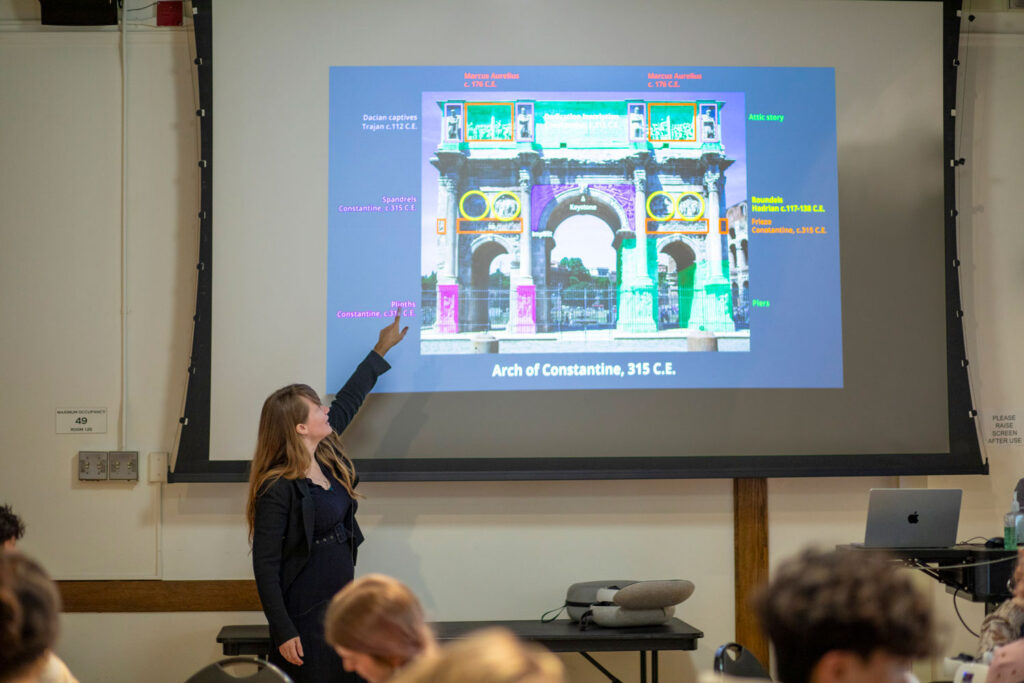
The Arch of Constantine is visited by millions each year. Standing approximately 65 feet tall and 82 feet wide, it is a celebration of Roman excellence and opulence. It comprises a complex mix of Corinthian columns, reliefs taken from the Basilica Ulpia, medallions dating to the reign of the Emperor Hadrian, and friezes celebrating Constantine.
When Nicola Barham teaches her undergraduate students about the Arch of Constantine and other Roman monuments, she not only details the historical and political context, she attempts to communicate the scale of the achievement and its visual impact.
Projecting photos on the screen or examining detailed pictures in textbooks only takes you so far. Barham, an assistant professor in the Department of the History of Art in the College of Literature, Science and the Arts, looked to technology to bring the monuments to life for her students.
“I’m trying to get students excited. I want the ancient world to come alive for them,” Barham said.
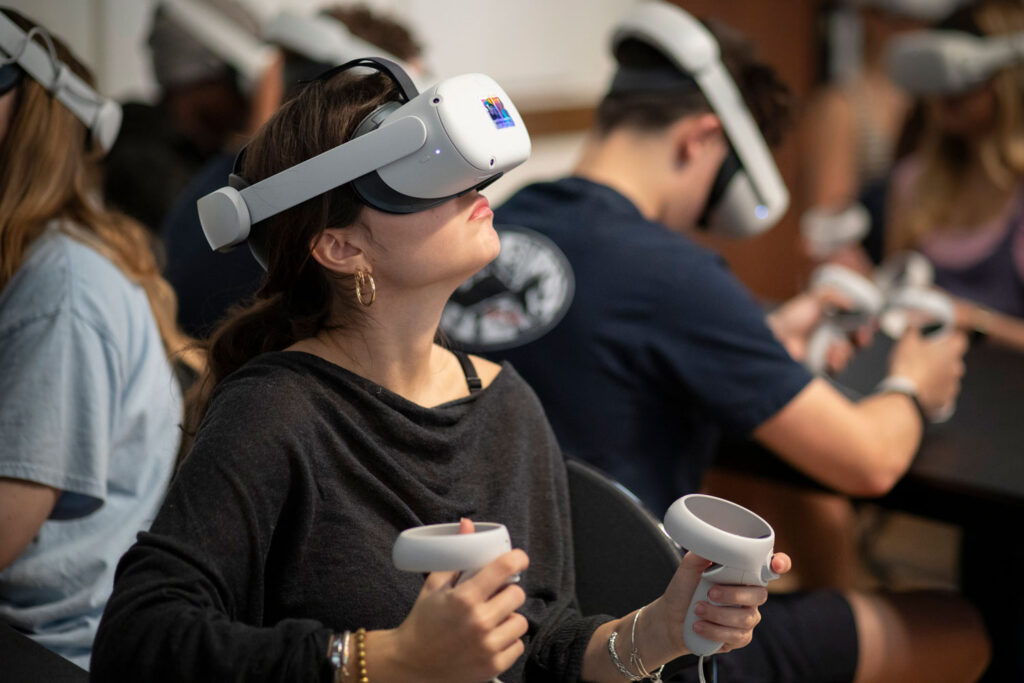
Since she couldn’t easily take a large class around the world to visit the monuments, Barham wanted to bring the monuments to them. She worked with the Center for Academic Innovation’s XR team to recreate key monuments in 3D and then have the students wear XR headsets during lessons to visit full-scale recreations in virtual space.
Students in her Visual Cultures of Ancient Rome course got to experience three sites in 3D – the Ara Pacis Augustae, the Pantheon, and the Arch of Constantine. Using XR headsets, students entered reconstructed environments where they could examine architectural details up close. They weren’t bound by distance, or even modern-day limitations like closed-off sections or protective railings that keep visitors at arm’s length. They weren’t even bound by gravity.
Students enjoyed the first session, which featured a look at the Ara Pacis Augustae (the Altar of Augustan Peace). They had just one request. Could they fly? The center team worked to enable virtual avatars to fly through the space, giving students the opportunity to view fine details from the floor to the ceiling in the 3D renderings.
“There’s something about embodied experience,” Barham said. “When you experience it, even in virtual space, it’s very different from reading about it… there’s a different level of cognitive impact.”
The experience offered a sense of scale and presence that you can’t get from a history book. Barham said students responded positively to the experience, taking to the technology quickly and reporting a better understanding of how monuments, such as the Arch of Constantine, were designed to shape perception, movement, and create meaning within Roman society.
“In the end, the product within a class isn’t the lecture, or the test, or even the technology. The product is the student experience and what my students carry with them afterward,” Barham said.
The collaboration itself was highly iterative, with Barham working closely with designers and developers to refine models for disciplinary accuracy—down to inscriptions and sculptural detail.
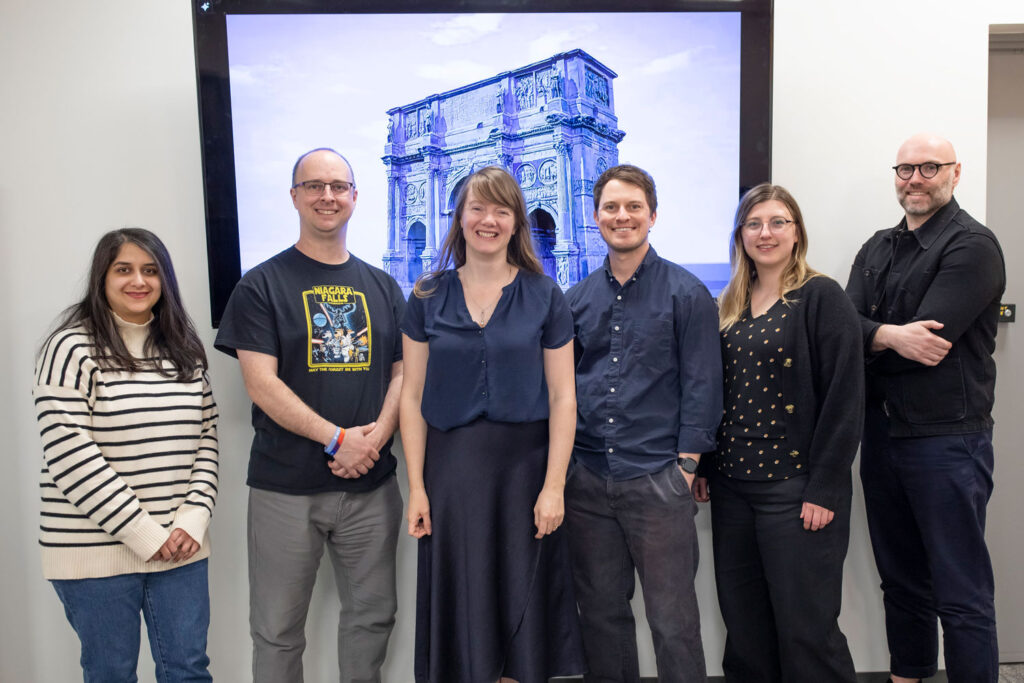
The center’s XR designers would find existing models in 3D available online and then work closely with Barham to adapt them, fixing flaws and missing details to make them as historically accurate as possible in the time available. The result was a set of tailored experiences that bridged technical innovation and historical accuracy.
Response has been so enthusiastic that Barham is planning to embed the experience within her Roman Sculpture graduate class in the Fall. She’s also exploring new ways of collaborating with different teams and departments, spanning history, art, and the university library. The goal is to create a broader digital archive of historical sites throughout the world.
“Wouldn’t it be great to have a library of high-fidelity 3D digital models of monuments from the ancient world? It becomes a resource for the future, and an insurance against decay, pollution, and the uncertainties of time. It would be a powerful resource to have an archive at Michigan where researchers in a century or two could know exactly how monuments looked in fine detail all the way back in 2026.”