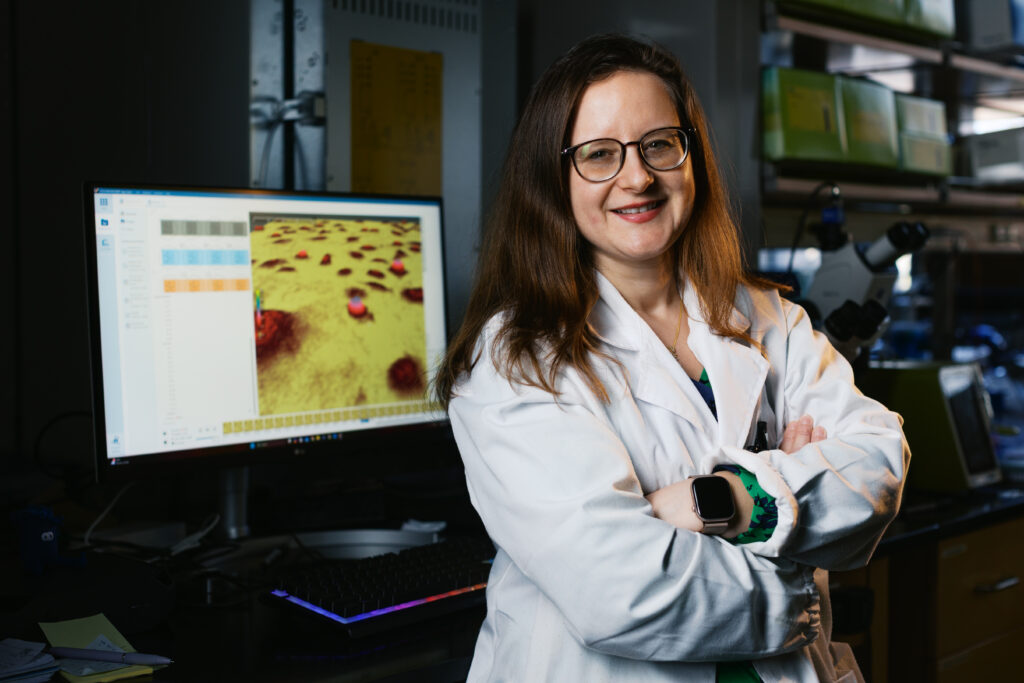
By pairing biochemistry coursework with Michigan Online certificates, Besa Xhabija helps students showcase their skills and stand out to employers.
Sean Corp, Associate Director of Communication
Many of Besa Xhabija’s students are the first in their families to attend college. According to the latest data, 44% of incoming students at the University of Michigan-Dearborn are first-generation students. For them, college represents something beyond academic achievement. These students are investing in their future and forging a pathway to stability, opportunity, and a career.
If students are investing so much in their education, Xhabija, an associate professor of biochemistry at UM-Dearborn, thinks she owes it to them to invest just as much into their future success. While her students are learning the foundations of biochemistry — DNA analysis, molecular biology, and laboratory techniques — she also wants them to graduate with the confidence and professional skills needed to navigate an increasingly competitive workforce.
Helping Hard Work Lead to Opportunity
Her approach grew out of her own experiences in science and research. Her family sacrificed everything they could to help her pursue science as a youth in Albania. It led her to college in Canada, a career researching cancer metabolism, and a passion to teach others.
“The students work very hard in their classes, and I want that hard work to actually lead somewhere,” Xhabija said.
That motivation led Xhabija to begin integrating Michigan Online courses and Google’s career certificates available through Michigan Online directly into her curriculum. She sees the platform as a powerful tool to help students connect what they are learning in the classroom to the careers they hope to begin after graduation.
“What I find is that sometimes students do not recognize the value of what they already know, and employers do not always see those skills reflected in a CV,” Xhabija said. “A degree has the power to open doors. Part of my job is helping students recognize the skills they have developed and communicate those skills effectively to employers, while also helping them see which doors are available to them.”
How Michigan Online Courses Help Students Build Career-Ready Skills
Xhabija uses Michigan Online, the platform that provides the U-M community with free access to more than 300 non-credit online courses created by U-M faculty and to content from partners like Google, to bridge the gap between academic knowledge and career readiness. She wants it to be clear to any hiring manager what skills her students possess, and wants to help her students tell their own story.
By embedding the ability to earn online certificates into her courses, she believes her students will graduate with a strong scientific education and proof of the technical and professional skills employers increasingly value.
“I really believe we owe it to our students to help connect education to opportunity,” Xhabija said. “Students are investing years of work into their degrees. We should also be helping them understand how to translate those experiences into careers.”
Bringing AI, Data Analysis, and Coding Into Biochemistry
Throughout her career, she has seen the increasing importance of coding, data visualization, and AI tools within medicine and biomedical research.
“With AI tools becoming more accessible, I thought, ‘We need to bring this into the curriculum because this is where science is going,’” she said.
When she discovered the breadth of offerings available through Michigan Online, she recognized how the platform could help enhance her students’ classroom lessons with real-world skill building.
Xhabija began incorporating courses such as “AI-Powered Data Analysis,” “Understanding and Visualizing Data with Python,” and Google’s AI Essentials courses into her biochemistry curriculum. Some courses focus on coding and statistics, while others emphasize AI literacy, data visualization, and communication skills increasingly valued across scientific industries.
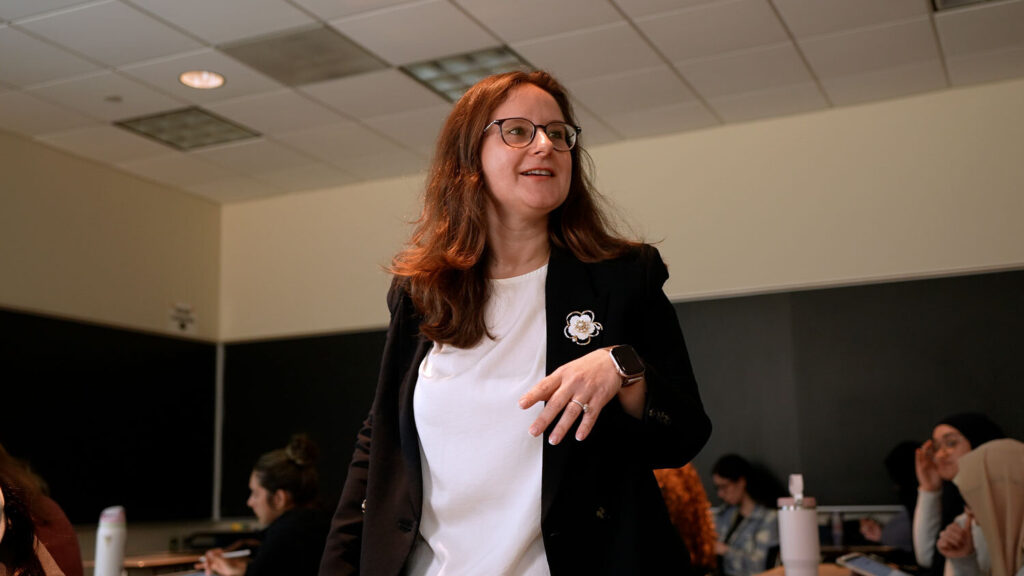
Students complete the certificates alongside traditional coursework. Early in the semester, Xhabija walks students through the Michigan Online platform and encourages them to explore additional courses connected to their personal interests and career ambitions.
“So far, what I’ve done is, for each class, I have prescribed between three to four different certificates that the students have to take,” Xhabija said. “The way that I tailor that is knowing where the students are at, what are the learning outcomes for the class and where the students would like to go.”
Helping Students Show Employers What They Can Do
One student interested in forensic science came to Xhabija shortly before graduation, frustrated that employers were not responding to job applications. Though the student had developed strong technical and analytical skills through the biochemistry program, those abilities were not clearly reflected on a résumé.
Xhabija worked with the student to identify additional online courses that result in certificates on Coursera, also available free to the U-M community through Michigan Online, in forensics, statistics and data analysis that better communicated those skills to employers.
“He had a Bachelor of Science in biochemistry, and now the three or four different certificates were speaking the language employers would recognize,” Xhabija said.
She has doubled-down on that approach and views Michigan Online as a critical tool in building each one of her courses. Alongside lessons in molecular biology and experimental techniques, students are learning how to responsibly use AI tools, analyze and visualize data, and communicate technical skills in ways that resonate with employers and graduate programs.
Opening Doors for First-Generation Students
She also believes introducing students to those opportunities early is especially important for first-generation students and others who may not already have professional networks or exposure to career-building resources.
“If I don’t introduce students to these opportunities, many of them won’t discover them on their own,” she said. “But once they see how these certificates can strengthen a résumé or support their goals, everything changes.”
Strengthening the Value of a University of Michigan Degree
For Xhabija, the work is not about replacing a traditional degree from one of the best learning institutions in the world.
“A University of Michigan degree is absolutely irreplaceable,” she said. “I think what we’re doing is actually strengthening the degree.”
She believes the future of higher education will increasingly involve helping students pair foundational academic knowledge with flexible, career-aligned learning opportunities.
“Our students are academically very strong, and they already have the skills they need for a particular career,” Xhabija said. “But sometimes students do not recognize the value of those skills, and employers do not know how to read them. Michigan Online helps close that gap.”