Briana Johnson, Marketing Copywriter
Song has been at the heart of Black performance for decades, from the inception of slavery in the United States to modern-day protests against police brutality, representing both a sense of empowerment and resistance. Black Performance as Social Protest, an open online course from Michigan Online, traces that history and impact in a new 9-minute musical film.
The short showcases the deep impact of song within the Black community and how, throughout time, it has served as a powerful force for change. Tracing this tradition, the short connects learners to oppression’s emotional and physical impacts and how the Black community has continually used song as a driver for social change.
Building the Narrative
Anita Gonzalez and Louise Toppin, lead faculty innovators, originally conceived the project after discussing the importance of providing learners with accurate portrayals of the environments that sparked African American protest songs. “We wanted to visualize the circumstances from which the songs emerged,” said Gonzalez, professor of performing arts and African American studies at Georgetown University and a previous faculty member at the University of Michigan. “When did they sing these songs, and why? What was the difference between a civil rights song and a church song?”
These guiding questions resulted in renditions of some of the most famous songs from the enslavement and civil rights movement; “O Freedom,” “This Little Light of Mine,” and modern-day protest songs are featured within the experience.
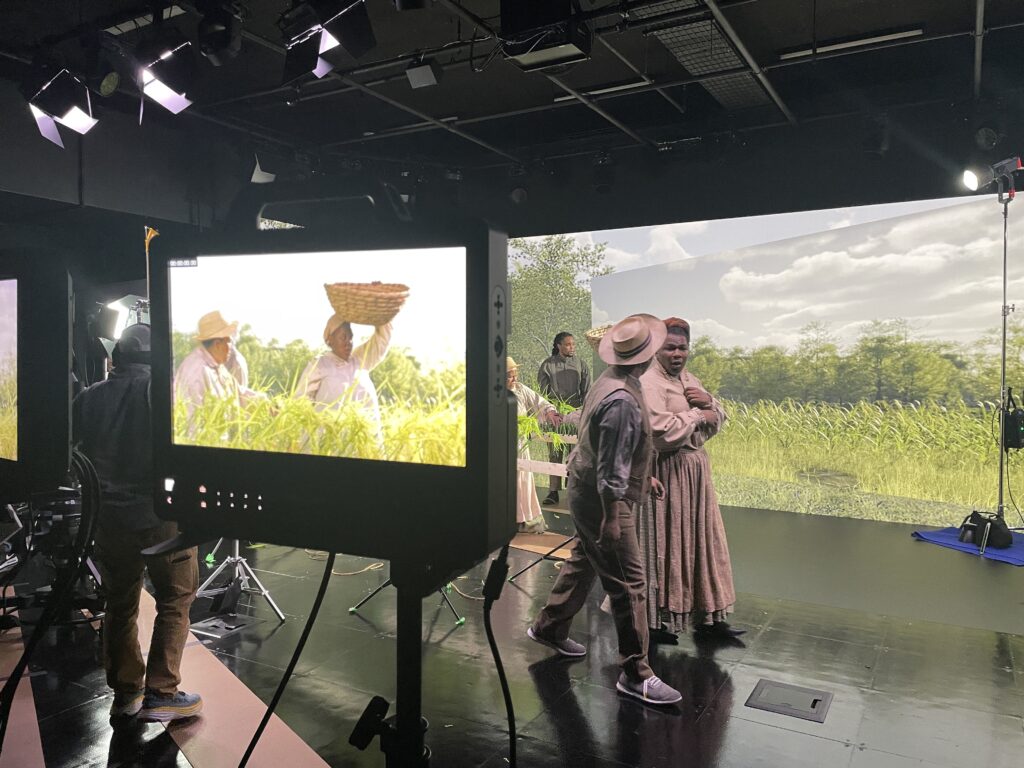
The project features the talents of a dozen student actors from across the nation, hailing from the School of Music, Theatre, & Dance at the University of Michigan. Tappan and Gonzalez stressed the importance of highlighting these historical periods and utilizing the singers’ and actors’ own experiences to bring life to each scene.
“It was a great experience, and allowing them to bring their personalities into it, to make it feel more alive,” said Tappan as she reflected on recording the music. “[By bringing in students’ personal experiences] people could hear the music in the context, rather than seeing three professors with the music walking around in a circle.”
Initially recording the songs in 2021, students brought their experiences from growing up in the Baptist church to their role in the protests following the wake of George Floyd’s murder in 2020, to the initial recording. As the team prepared for the recording of the video, Tappan and Gonzalez focused on ensuring that the actors shared similar experiences and could highlight their own story within the recording, fostering a sense of connection and empathy.
“Where Black music is, is just as important as what black music is,” said Tappan. “Seeing [the songs] in the context of you having people walking across the bridge or in front of chili bowls, the place is important to the music.”
Knowing they wanted to intentionally tie the visual aspect of the production to scenes emblematic of the Black experience in America, Tappen, Gonzalez, and their collaborators at the University of Michigan’s Center for Academic Innovation and Georgetown University storyboarded out the scenes for the shoot.
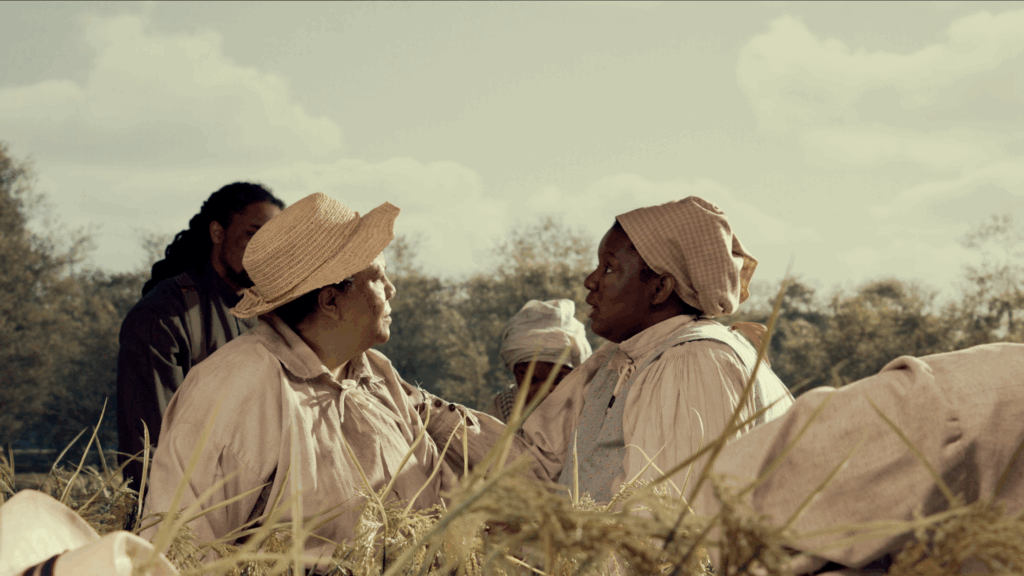
The musical film offers a poignant journey through Black experiences before and after slavery, defining the power of song and spoken word as tools for joy and resistance. From the labor of sharecropping fields to the spiritual refuge of the Baptist church, it traces how these cultural spaces became vital centers of community and healing in the aftermath of enslavement. The story builds to a reenactment of the historic civil rights march across Selma’s Edmund Pettus Bridge, then shifts to scenes of modern-day protest, comparing the spoken-word traditions of the ‘60s and ’70s and how they echo within today’s social movements.
Setting the Scene with Intention
The production came at a pivotal time, not just for the team but for the center overall, as they began constructing their extended reality stage in 2023. Early on, it was clear the stage’s XR capabilities could help the Black Performance instructors meet many of their goals without needing to travel to the specific locations they hoped to recreate. The project blended actors, virtual environments, and metahumans to give each scene additional depth and feel.
Unlike a typical video production shoot, where most of the creativity comes with shooting the day of or editing in post-production, virtual production stages require considerable pre-production planning. By locking in the storyboard early on, the virtual production team at the center could plan the proper shots and ensure that the dozen actors set to join the team could blend comfortably into the virtual environments.
“It was crucial for me to communicate with the team the limitations of the stage, while creatively providing alternative solutions,” said Chiemela Mgbeahuru, virtual production producer at the center. “It required careful planning and precise stage marking to position about a dozen actors effectively on our stage. That way, they weren’t too close to the LED wall, which displayed the digital environment, and also kept enough distance from the camera to create space for foreground props to maintain proper depth.”
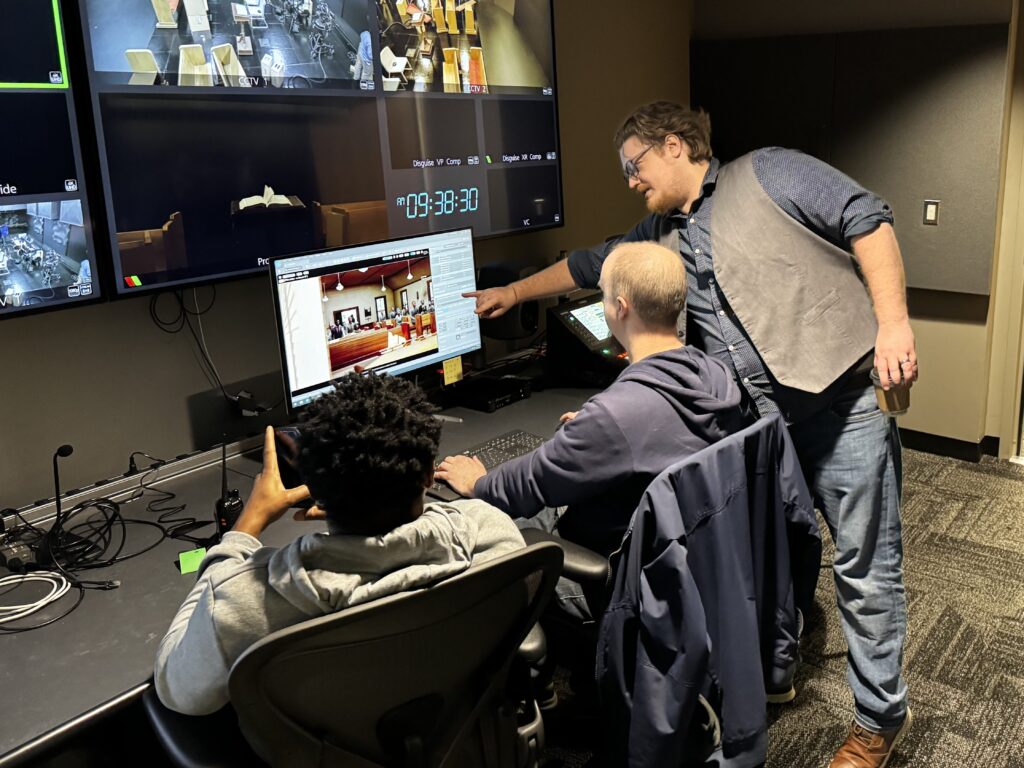
To allow a seamless feel between the digital backdrop of the stage and the real-life actors, the team used a series of foreground props to mask the virtual ground and 3D renderings for wider shots.
By using a blend of extended and virtual reality technologies, the team was able to recreate iconic historical scenes digitally, providing a cost-effective approach to filming. “Louise was a key resource of information for me,” said Ray Majewski, XR environmental artist responsible for many of the creations of the iconic Pettus Bridge and church scenes in the film. “Having grown up part of the Baptist Church, and her family having a rich history in those environments, she was able to pull from that lived narrative of what she remembers how the church felt, and so there’s a lot of emotional inspiration.”
The center’s media design and extended reality teams were equally thoughtful in setting intentions on set. “There’s a lot of thought that went into the very beginning stages of this project,” said Jeff Butler, media design and production lead at the center. “We found it to be an incredibly important story to tell, something that we hadn’t done before, which excited many of us.”
The team shot each scene over three days in the spring of 2024, the whole team buzzing to dive into a project that was years in the making. Knowing the subject matter involved acknowledging the harm done throughout the years to the Black community in the United States, the team set out to create an air of openness, acceptance, and understanding throughout the days.
Knowing that students and instructors alike had experiences that were shaped and impacted by this history, they knew keeping the energy light was essential to ensuring that the actors felt comfortable. “I knew that because the subject was heavy, we needed to try to keep the energy up, positive, light, and talking to them about other things,” said Tappan. “When we were off stage, we were talking about the latest concert they saw, or something we read in an article. As a teacher, we don’t get those opportunities because we’re in front of them teaching and not actually in something. I’ve never had an opportunity to really interact with my students like that, and it was fun.”
This energy equally extended to the production crew. “A lot of it was sitting back and just listening to people because of their experiences,” said Butler. “It’s making sure that you’re elevating a voice, and that it’s being done from a technical standpoint. That’s where we could step in.”
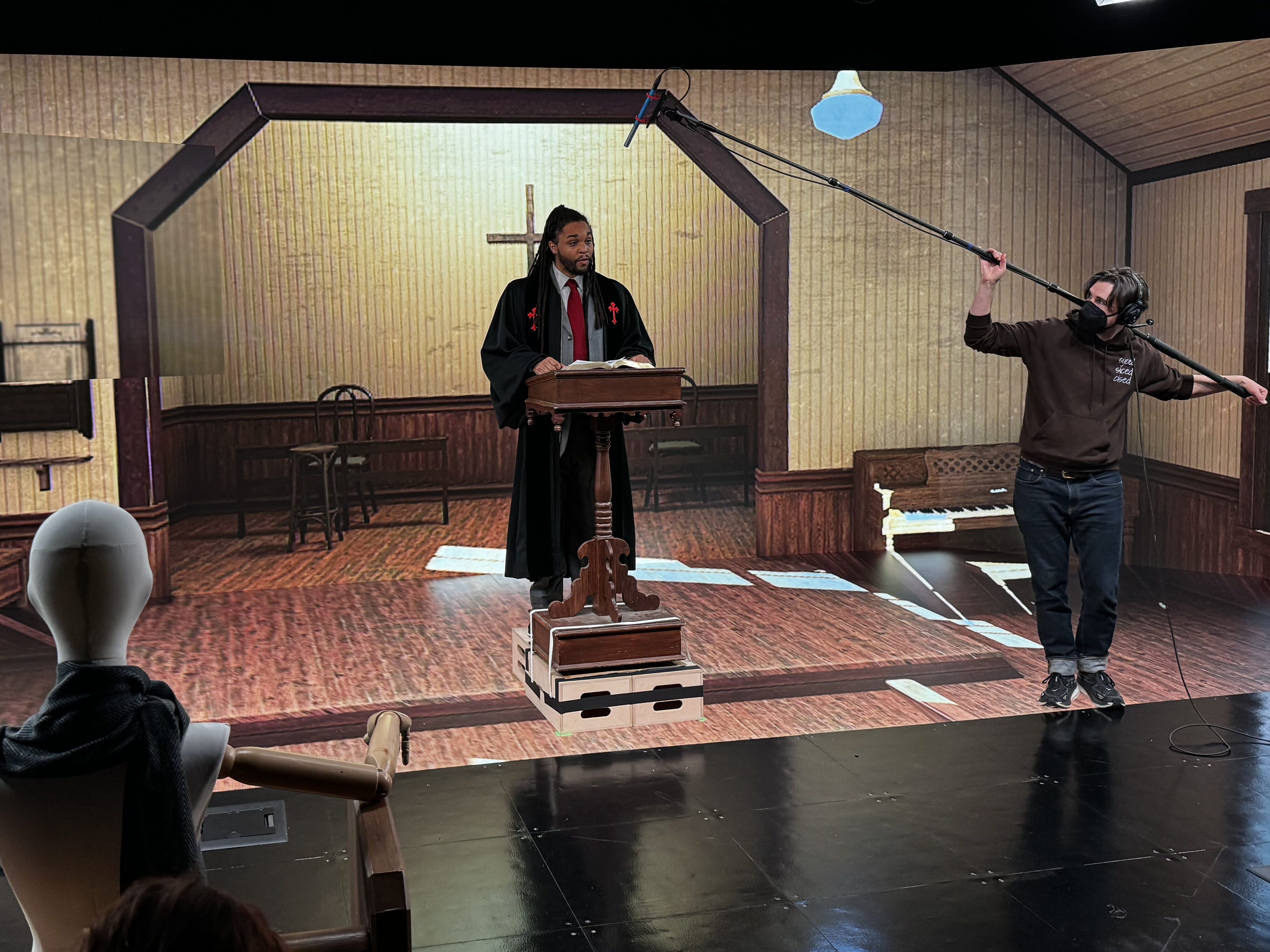
The production of the short, musical film would span over a year, from recording to the final stages of post-production, eventually being integrated into the course Black Performance as Social Protest. “It was fascinating to watch the scenes move with us, to watch the metahumans in the scene with us,” said Tappan as she reflected on the day of the shoot. “I’ve never done anything like that.”
Shaping the Future of Education
Black Performance as Social Protest is one of the center’s biggest and most complex projects to date, relying on the talents of faculty, staff, and students from around the university and the country to utilize innovative technologies to explore the Black experience through storytelling.
“This project provided a unique opportunity for U-M’s Center for Academic Innovation to push the boundaries of emerging technology and bring Professor Gonzales’s vision on this important historical subject to life. Virtual production allowed us to create an experience that was previously unattainable and set the foundation for what U-M can do to impact the future of teaching and learning positively,” said Jeremy Nelson, the center’s Chief Technology Officer.
As for the musical film’s outcomes, the team was excited to be able to share the experience with the world. “We were thrilled,” said Gonzalez. “It was a fantastic experience to work with the incredible crew at the center and to see how open-minded and willing the team was to experiment. They were extremely supportive of the process in ways that went way and way above and beyond the call of duty.”