By the XR Laboratory Health and Safety Training team
Laboratory safety training is one of the most essential parts of preparing students for hands-on research. Every year, thousands of undergraduates step into labs for the first time, and ensuring that they can work safely is a responsibility the university takes seriously. Unfortunately, while the science and technology they study have advanced rapidly, the methods for delivering safety instruction have remained stuck in the past—often outdated, unengaging, and disconnected from the digital tools students use every day.
Although information-sharing capabilities revolutionized our digital world, and today’s students come equipped with the skills to navigate these platforms, safety training technologies have lagged behind, as some of the training applications were created before this year’s first-year class was born. In the age of almost infinite possibilities at our fingertips, we should be leveraging innovative technologies that maximize the effectiveness of safety training through experiential learning, and not just through informing (which may not translate into accident preparedness). Lab safety is not all about knowing; it is also about doing.
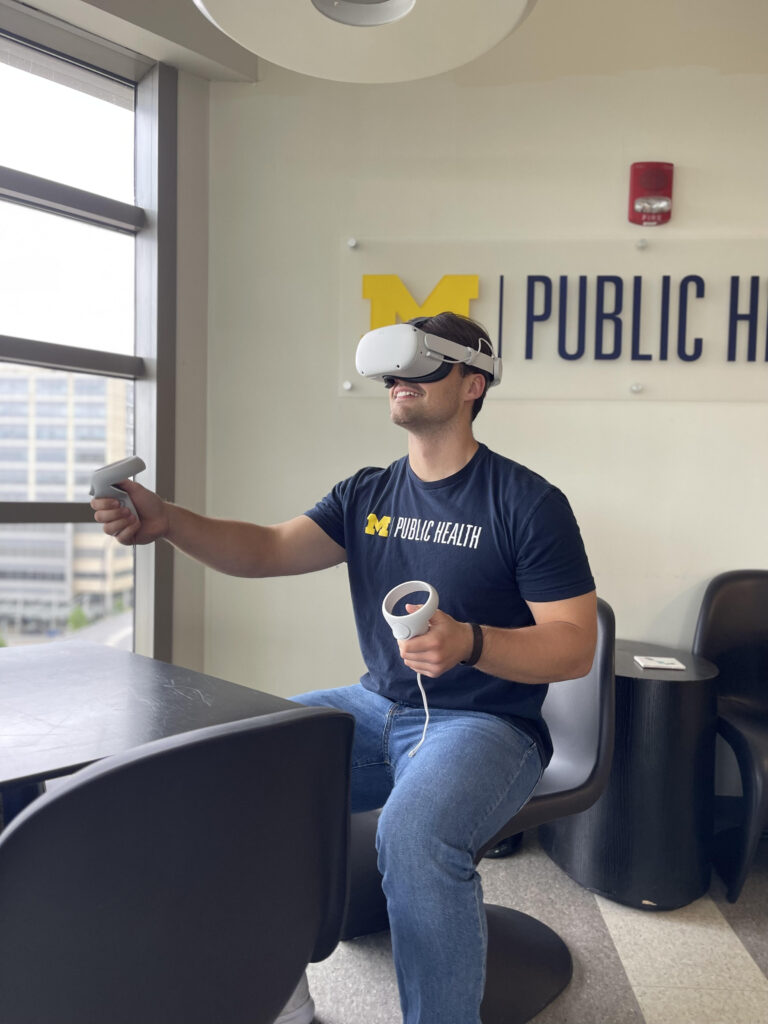
With support from the Center for Academic Innovation, alongside the School of Public Health’s Instructional Services and Media Services teams, the XR Laboratory Health and Safety Training team developed an immersive laboratory training experience, which is accessible via the web, mobile device, or virtual reality goggles. Using this approach, we are able to present lab safety concepts and information in an engaging, realistic, and innovative manner.
Initial testing with students in the School of Public Health has provided promising feedback. Every student reported that they agreed or strongly agreed that “training enhanced my ability to apply lab safety skills in a realistic context” and “the VR experience made (them) feel that they were in a (virtual) lab.” Ninety percent of respondents ranked it better than the traditional training methods they had experienced. One student noted that, “it was more engaging which allowed me to follow through with each step…” Another remarked, “I could explore the lab space at my pace and try modules more than once if needed. The video demonstrations were helpful to show how to use equipment and were an improvement over pictures and text.”
The development team is expanding this project in collaboration with U-M’s Environmental Health and Safety and Innovation Partnerships groups to optimize this technology and test whether the use of immersive XR technologies enhance learning and retention of critical lab safety concepts within a variety of laboratory settings and workflows.
Please contact [email protected] for more information.
XR Laboratory Health and Safety Training Team