Mindy Arbaugh, Content Specialist
Extended reality (XR), with its immersive experiences and risk-free learning environment, is an exciting option for faculty and staff looking to make online courses more engaging. Yet is this technology always the best vehicle for instruction?
To explore that question, the Center for Academic Innovation launched the Extended Reality Education Design (XRED) project for the 2025 Summer term. The project was an open-ended challenge to explore how XR could enhance both existing and future Michigan Online courses.
Five CAI Student Fellows explored XR use in online courses, focusing on analyzing the technology, its use in course activities, and potential impact on learners. They ultimately developed a toolkit that could help faculty and staff determine the technology’s effectiveness and when to implement it.
“We wanted to task them with contributing insights on how (XR) fits in with course design and build frameworks that we can use to better collaborate with partners of CAI,” said Amanda Cowell, experiential technologies project manager.

What is CAI’s Student Fellows program?
The center’s Student Fellows program offers an opportunity for University of Michigan students to experience a professional, cross-functional working environment under the mentorship of center staff.
Research Reveals Challenges
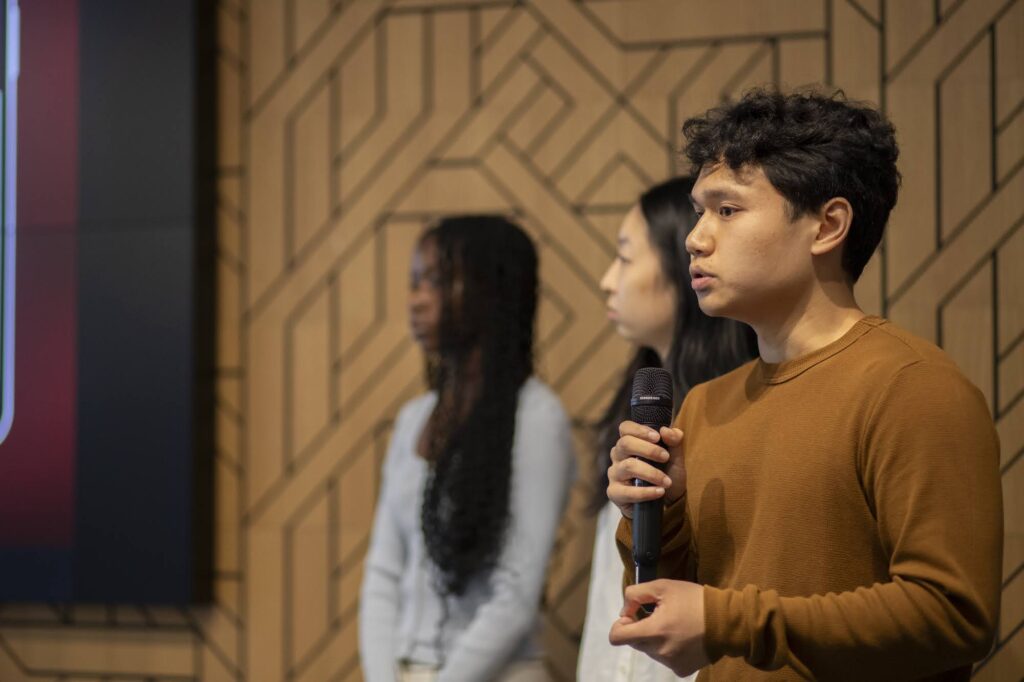
The five XRED Student Fellows – Zoe Corser, Kavya Jeganathan, Jingmin (Jane) Mei, Ben Luu, and Oluwatosin Oyelade – started with discovery, looking into recent research on XR’s use in teaching and learning. The technology has, for example, shown potential in helping students excel at comprehension, evaluation, and creation-based tasks. Yet there is also the risk of the novelty effect, or the initial enthusiasm learners have for technology that ultimately fades after prolonged use. Because XR is still primarily built for games rather than learning experiences, the team wanted to understand how the technology best serves students.
“Trying to force XR in a situation where it doesn’t fit in really creates a lot of big problems,” said Luu, the XRED research and impact fellow. “Putting it into an educational setting will take some time to figure out whether students actually like it.”
The team pursued user testing on two Michigan Online courses featuring augmented reality (AR) experiences – “The Nurse’s Toolkit” and “People, Technology, and the Future of Mobility.” Results were mixed, with some users finding value in the AR activities, while others gained more from traditional learning. The team did surmise that AR was a better conduit of information when students had control over their experience, namely the ability to pause and rewind in order to learn at their own pace.
More importantly, they found when the AR tools aligned with the course’s standard materials, like terminology and slideshows, they were valuable extensions of the lessons. By pairing passive learning with active exploration, AR helps students interact more deeply with course content.
“AR should be a supplement to traditional learning,” said Jeganathan, the XR user experience fellow on the team. “It should never replace it.”
Designing an AR Toolkit
Next, the team designed a framework to address these issues and provide a smoother pathway to integration. They focused on AR technology for its strong functionality and created the AR Design Toolkit.
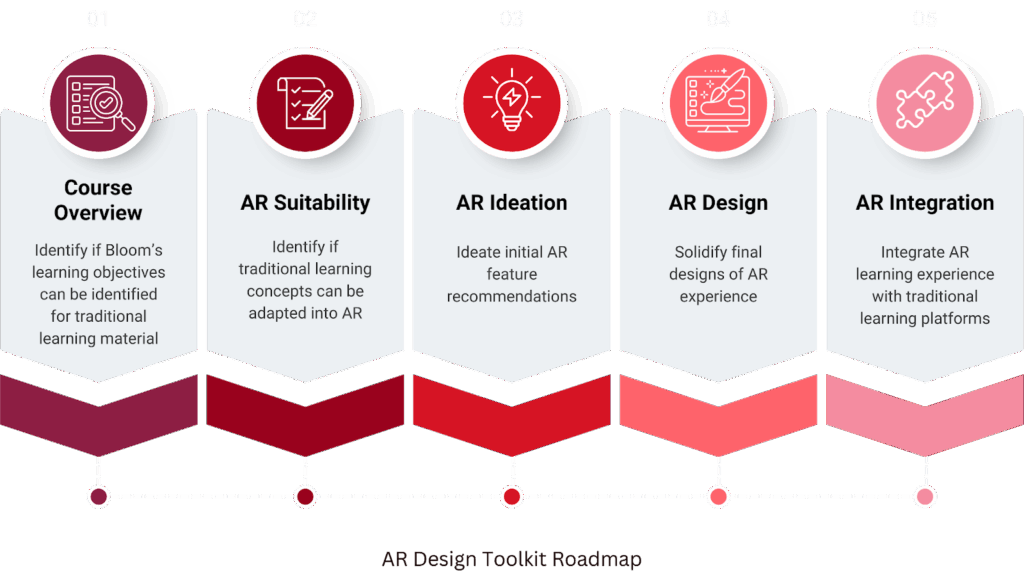
The toolkit outlines the process of determining if AR technology is suitable for the course, organizing it into five phases – course overview, suitability, ideation, design, and integration.
Step one of the toolkit involves analyzing the course’s learning objectives and considering which AR activities best suit those goals. For this step, the XRED team developed a score sheet to help faculty determine which aspects of their course best aligned with a potential AR experience.
From the suitability score sheet, the toolkit heads into the ideation phase, where the XR team designed a series of prompts to help course designers settle on a final AR concept. That guidance would continue through the design stage, and finally toward an AR product that’s ready for implementation in the course.
“The design toolkit that we built out, we really wanted to have a process that could be repeated when it comes to creating AR materials and integrating them into courses,” Jeganathan said.

Launching A Prototype
To test their toolkit, the XRED team worked on designing and developing AR experiences for the “The Basics of Rocket Science” course on Michigan Online. The students selected it from more than 30 potential courses, hypothesizing that an AR experience could help learners visualize and interact with the different orbits featured in the course.
Using the AR Design Toolkit, the team developed a prototype, not for implementing into the course, but instead to test and explore the process of using the toolkit. They created three prototype AR activities – an altitude experience, an inclination experience, and an eccentric orbit experience – that would supplement the module on orbits.
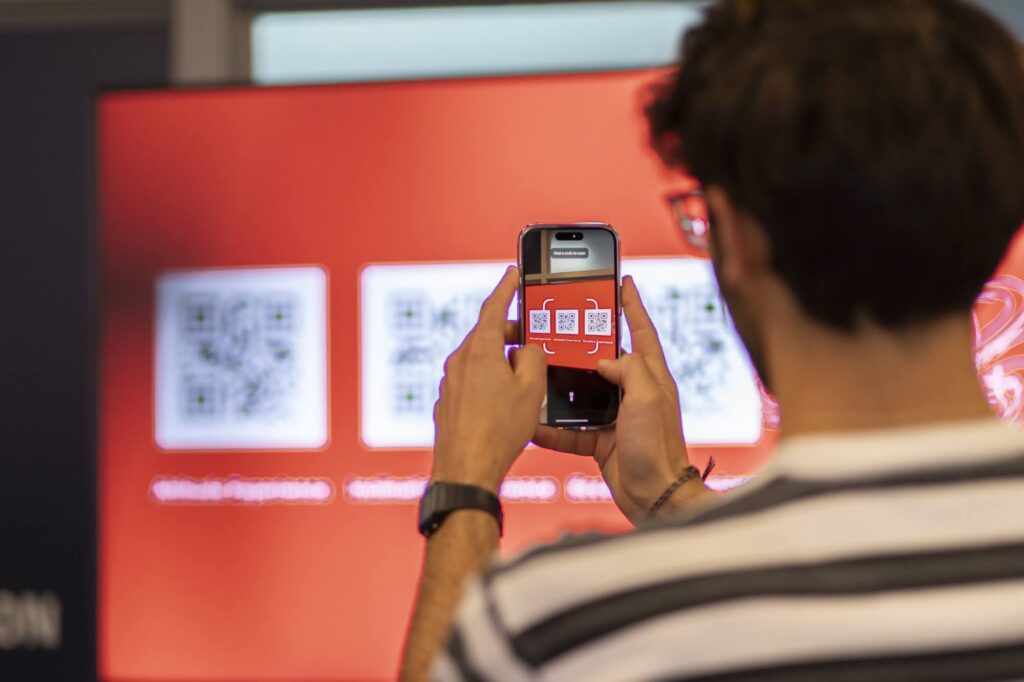
Accessible on computers and mobile phones, the interactive features offered a selection of perspectives and included features like audio, information buttons, and other guidance for exploring the different orbits.
“We wanted to make sure that users were able to interact with the different elements within these experiences and also be able to do a compare and contrast,” said Corser, XRED’s technical project manager.
Tools for the Future
While the students all acknowledged that additional research and development are needed, the project’s initial progress left them satisfied with their accomplishment.
The AR prototype the XRED students developed will serve as a demonstration tool for future course design, and the toolkit showed that implementing technology in the right way is an important part of effective online instruction.
“Working with the XRED students this summer was a truly great experience,” said Eric Schreffler, XR developer lead. “They not only successfully tackled a project with ambiguous end goals, but they were able to develop processes and documentation that the XR team will be able to use for many of our future projects.”
One XRED team member said that developing a framework for XR implementation, a toolkit that didn’t yet exist at CAI, was a worthwhile accomplishment.
“This is something that’s needed and I think it motivated me, and probably motivated the rest of the team too, to feel like we’re doing something impactful,” Corser said. “Like everyone’s adding XR, but are they doing it with intention?”