CAI hosts industry leaders, U-M faculty, and students for a day exporing how 3D technology skills can translate into new opportunities
Mindy Arbaugh, Content Specialist
As soon as she heard about the event, University of Michigan senior Eugenia Hernandez-Martinez knew she had to attend.
The event, Designing an Unreal Future: An Epic x Michigan Industry Day, was co-hosted by the Center for Academic Innovation and Epic Games and welcomed industry professionals, U-M faculty, and students for a day exploring innovative uses of 3D technology and the careers behind them.
An engineering and computer science major with the College of Engineering, Hernandez-Martinez jumped at the opportunity to connect with industry leaders in real-time 3D creation.
“There isn’t a lot on campus about the intersection of these two,” Hernandez-Martinez said. “I knew I needed to sign up because it is very much what I’m interested in.”
Nearly a hundred people attended the Sept. 18 event, including representatives from Epic Games, Rivian and Volkswagen Group, Omnicon, Bombardier, Ford, and General Motors. James DeVaney, the center’s founding executive director and associate vice provost for academic innovation, said the gathering embodied the center’s mission to enhance the U-M education and provide learners with experiences that prepare them for today’s workforce.
“It illustrates something that we have learned repeatedly at the center over the last 13 years: many of the most interesting possibilities emerge when we bring people together who don’t ordinarily find themselves in the same room,” DeVaney said.
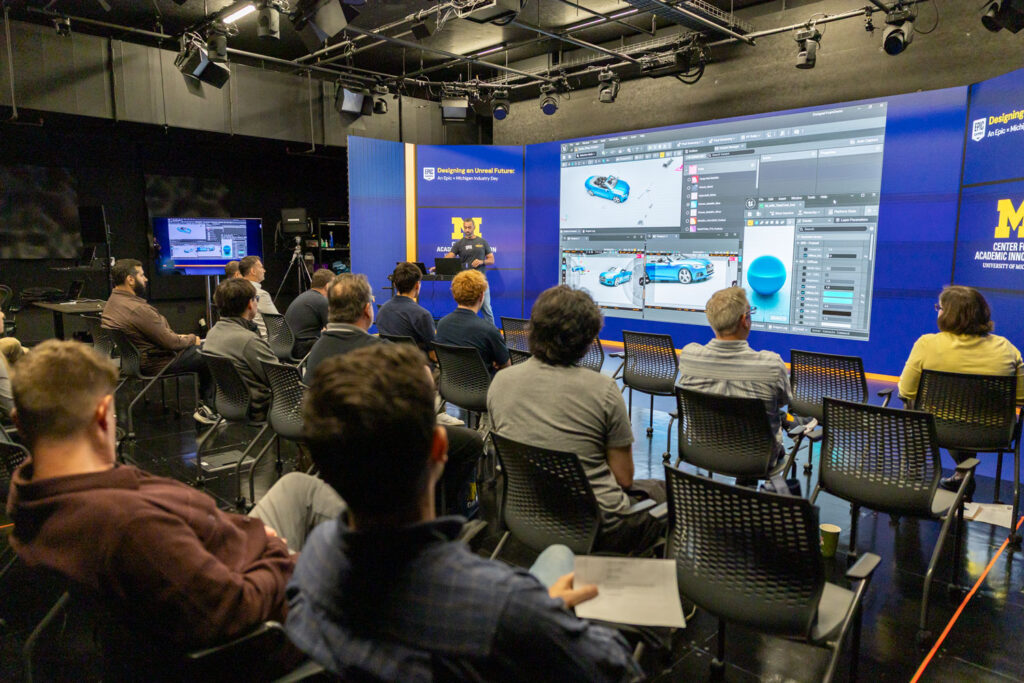
Event attendees packed the rooms at the center’s Maynard Street location for panel discussions, portfolio reviews, use-case presentations, and interactive demonstrations. The overarching message emerging from the day was that while technical skills are needed in today’s tight job market, human traits like curiosity, adaptability, and innovation are what will build careers.
Career Opportunities Beyond Games
Throughout the sessions, presenters emphasized that those careers, many of which utilize tools like Unreal Engine, Epic Games’ real-time 3D creation technology, are increasingly occurring outside of game development. Attendees learned that Unreal Engine, known as a software suite for popular games like Fortnite, is also being used in advertising, aerospace design, movie production, and more.
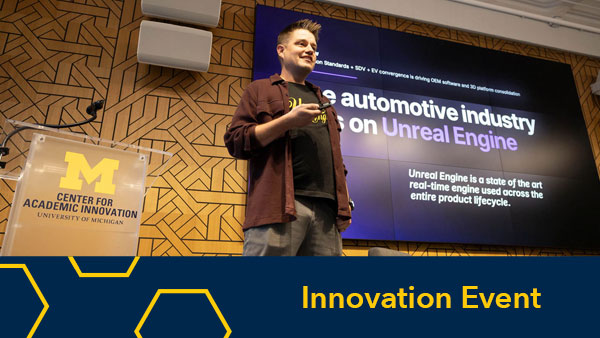
Keynote speaker Aaron Vlk, business development director at Epic Games, presented examples of non-game companies using Unreal Engine, such as advertising agencies developing digital reproductions of cars or movie studios building simulated backgrounds to replace green screens.
“What we see out in the industry is everybody’s looking for talent, and students want to learn, they want to build the skills,” Vlk said. “So really, whatever you’re working on here at U-M today could probably be applied to any enterprise.”
Austin Yarger, who lectures on game development, extended reality (XR), and 3D art at the College of Engineering, said the skills needed to create, design, and launch a game easily translate to other industries. His breakout session featured examples where those skills could be applied to non-gaming ventures, like virtual reality training modules for first responders, field trips to the Titanic shipwreck, home design, and event visualizations.
Yarger encouraged the attendees, many of whom aspire to work as game developers after graduation, to be open to starting their careers in a different industry.

The message resonated with Vadim Monakhov, a senior computer science major.
“I’m a huge fan of video games and video game development, and I want to be a game designer one day, but the market is tight,” he said. “Expanding my field of view is helpful because I already know these tools. Why not just apply them somewhere else?”
Curiosity, Collaboration, and Solving Problems
Yarger also lauded the value of learning multiple programming languages and game engines, as well as exploring related fields like 3D art and XR. When students learn these tangible skills, he said, they also demonstrate their flexibility and adaptiveness.
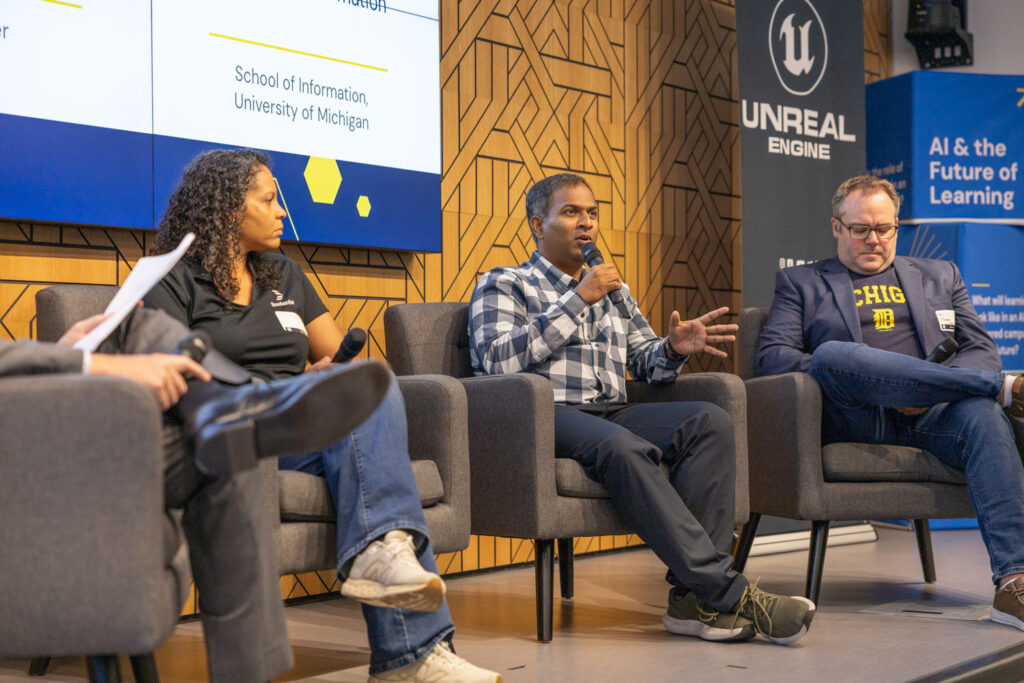
Suzanne Dove, chief education solutions officer at the center, led a panel discussion on careers in real-time 3D technology and asked the audience if they identified more with being a builder, an artist, or an experimenter. Many raised their hands for more than one. Anthony Fox, lead technical artist at Omnicom Content Experiences, said today’s graduates can, and should, be all three.
“You need to know a little bit about being a builder, you need to know a little bit about being an artist, and you need to be experimenting with anything else that’s out there,” Fox said. “I think the most important thing that you can have is curiosity to know how things are made, and figure out how things are made.”
Coming in with knowledge of the latest technology is something Rebecca Taylor’s group at Bombardier values in their newer team members.
“The reality is that we don’t necessarily know how to use (the latest) technology, so we rely on people who are up to date that come and provide us with that guidance,” said Taylor, who is a lead technical artist for the aerospace company.
Aunmar Mohammed, a solutions architect for Epic Games, said he’s seeing teams focus more on improving the systems around Unreal Engine than on the game engine itself. He advised students to understand the systems in order to be able to contribute from day one.
“It’s being able to see the problems and to be able to create solutions and unblock those things for people to work far more efficiently,” Mohammed said. “Everything is booming at such an incredibly rapid pace; it’s hard to keep up. So if you can save a massive amount of time, companies are going to appreciate that immensely.”
Keeping Pace with AI
Michael Nebeling, an associate professor at the School of Information and College of Engineering, said that while companies may hire for a specific specialty like XR, graduates should be open to working outside their area of study and continue growing their skill set. For many, a key to that growth will be AI.
“I want you to experiment with AI, not to replace yourself, but to figure out how it can actually make you stronger,” Nebeling said. “I think it’s important to stay in the game.”
The evolution of interactive advertising is one example of how AI is pushing technology in exciting new directions. Eric Nesser, global director of 3D and interactive at Omnicom, shared examples of systems using Unreal Engine technology in innovative ways, such as customizing the digital rendering of a car on your television screen using only your remote control, or having AI agents create product videos without human direction.
Nesser said the advertiser’s job is no longer to create assets but to create the systems that create the assets. Understanding AI is key to knowing how to manage, enhance, and ultimately scale those systems.
“You’re not going to get hired unless you can demonstrate you can do that,” he said. “That’s just table stakes right now, and it’s worth something in the market.”
The expectation of weaving AI into work has trickled down into the classroom. Bill Thompson, a lecturer at the School of Information who spent more than two decades leading user experience at General Motors, said students are seeing how much more they can do with AI, from identifying the goal to building the system and then executing the strategy to reach it.
“We know who we’re solving for, and we can put more meaning behind the design work,” Thompson said. “And AI has been a huge accelerator for that.”

An Epic Day at U-M
Many hoped that students walked away understanding that developing games, and acquiring the skills required to build them, could lead to different yet equally fulfilling career paths.
Hernandez-Martinez said she had been looking beyond the game industry for a place to apply her skills and develop her interests. When she saw that representatives from Rivian and Volkswagen, Ford, and GM would be reviewing student portfolios, she signed up.
“I’ve been looking more into applications of game engines and 3D outside of game development, so that’s why I attended,” she said. “I would eventually like to specialize more in the intersection between art and technology.”
DeVaney said the center’s partnership with Epic Games, which began in 2020 when the center received an EpicGrant for its XR Initiative, has continued to evolve and bear fruit, much like the technology featured throughout the day.
“People hear the phrase ‘game engine’ and understandably think first about entertainment, but an engine brings together assets and capabilities and renders them into many different experiences,” DeVaney said. “We do something similar at the center. We bring together faculty and student ideas and talent, professional tools and educational infrastructure, and our partners to create new forms of learning and opportunity.”
Partner with CAI to Prepare Students for Success
U-M faculty are invited to propose new online learning initiatives that expand the reach of a U-M education and help learners meet their professional goals through the Center for Academic Innovation’s 2026 Call for Proposals. Funding and support is available for both non-credit opportunities, centered on the theme Skills to Meet the Moment, as well as for-credit and hybrid programs. The non-credit proposal deadline is Nov. 6, and for-credit proposals are due Dec. 18. View all CAI calls for proposals, or email [email protected] for more information.