AI & the Future of Learning Summit brings industry, education leaders together to discuss higher education’s opportunity to lead, what students need, and what partnerships are possible
Sean Corp, Associate Director of Communications
As artificial intelligence rapidly reshapes the nature of work and learning, speakers at the University of Michigan’s AI & the Future of Learning Summit delivered a clear message: higher education must take a leading role in defining what comes next.
One CEO of a leading educational technology company put it like this: “The only bad thing would be universities standing still.”
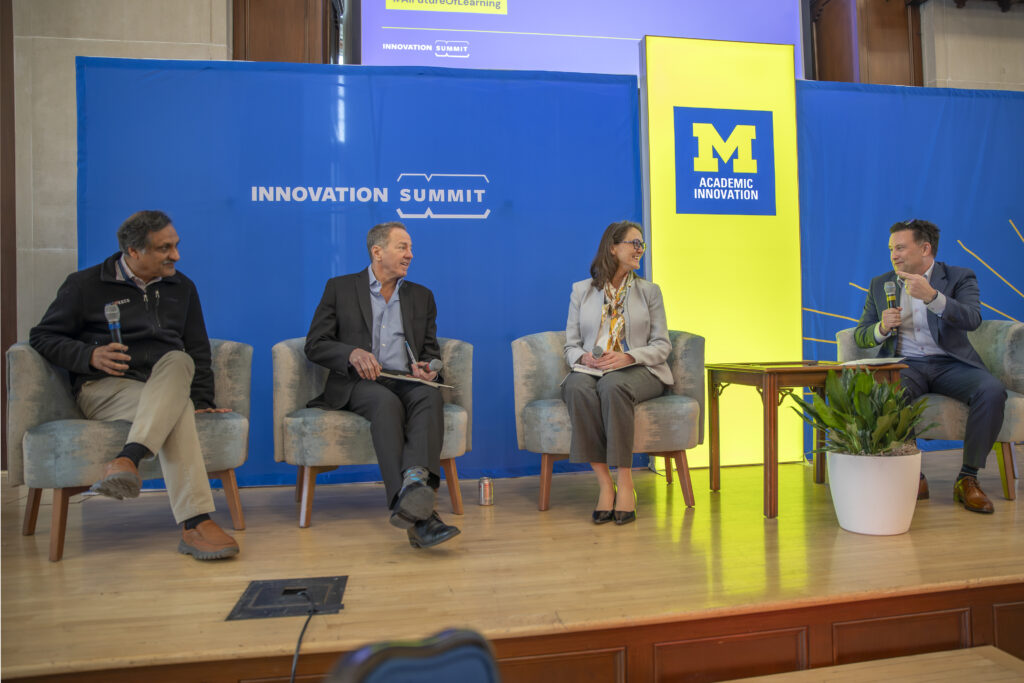
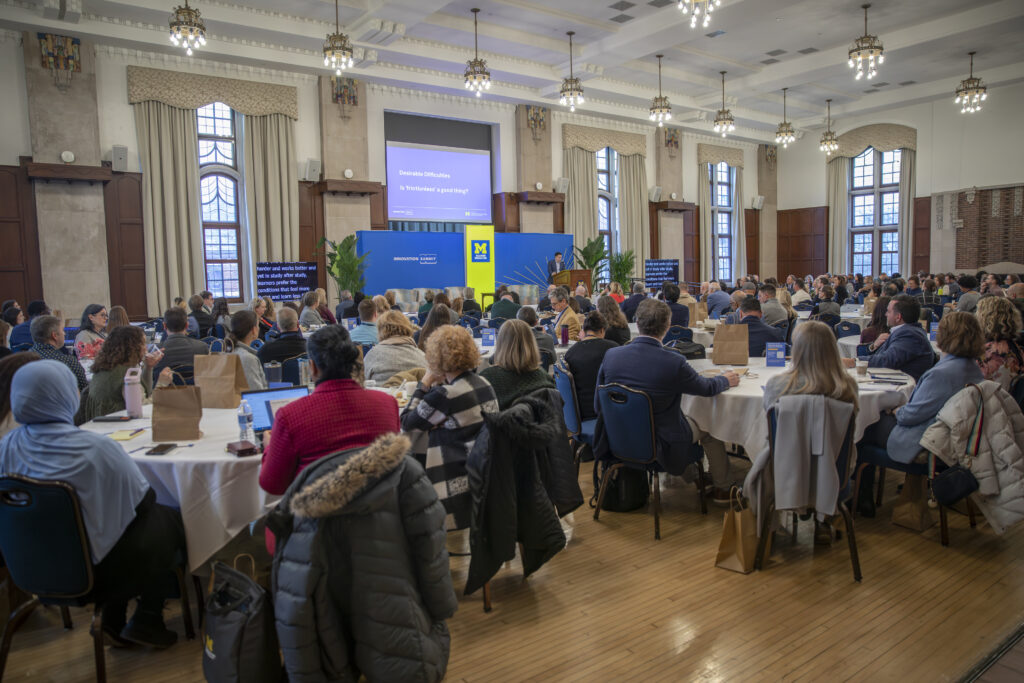
Speakers at the event, representing industry, higher education, and AI-powered platforms, outlined the landscape, projected future technological advancements, and discussed their impact on student experience and the labor market. More than 300 people packed the Rogel Ballroom for the summit, which was part of U-M’s Campus of the Future focus as part of the Life-Changing Education theme year. While the speaker lineup featured a heavy dose of industry insight, those in attendance included deans, provosts, and faculty from U-M and other universities.
The message the audience received was clear – AI isn’t going anywhere, and its impact on the present and future of learning and work will be profound. That led several speakers to argue that new models of teaching and learning are needed. Gone are the days of spending four years preparing students for a lifelong career they begin immediately after leaving campus.
“We have been chasing skills, and working to close the skills gap so students would be ready on day one of a job,” said Anant Agarwal, founder of edX. “There’s no day one anymore.”
If there is no day one, there is also no last day of school. Technology changes too quickly, and there is a growing, continuous need for education to support job changes, reskilling, and upskilling throughout a lifetime.
Perspectives from Industry and Academia
Universities must embrace their roles as providers of continuous, lifelong learning that evolves alongside technological change. Acknowledging that change is needed is one thing. Knowing how to make that change happen is another, and several speakers explored how education is delivered and who it serves could change in the future.
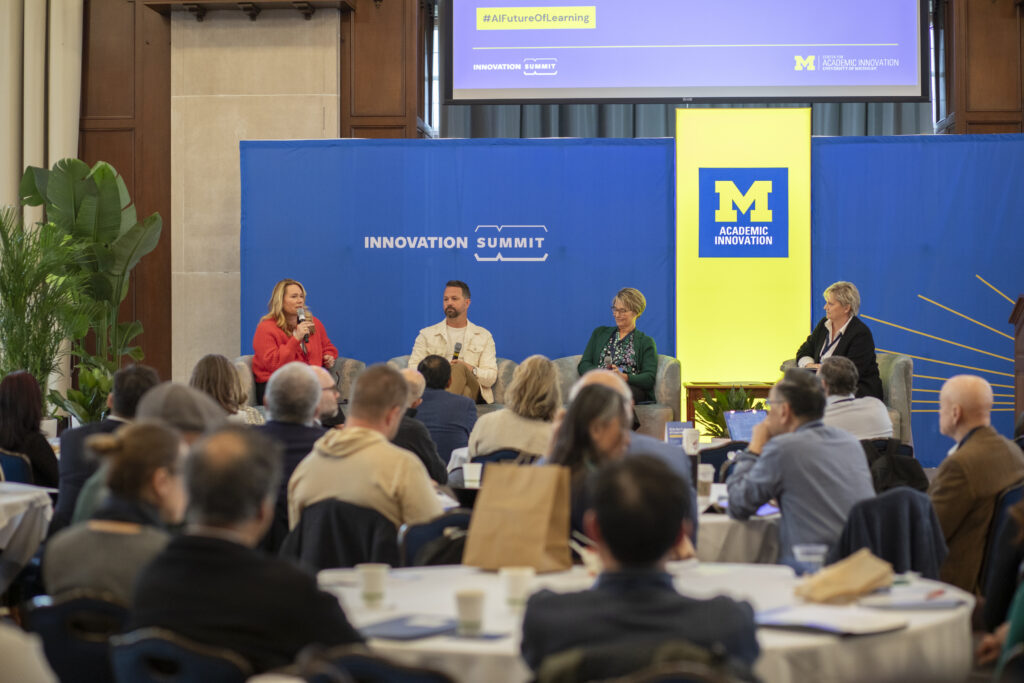
A recurring theme throughout the summit was the need for higher education to balance two roles: grounding learning in academic rigor while staying closely connected to a changing world. This theme was reflected in the roles of summit attendees, including current and former faculty, CEOs of edtech firms, and industry leaders from companies such as Salesforce, Amazon, Microsoft, and Superhuman.
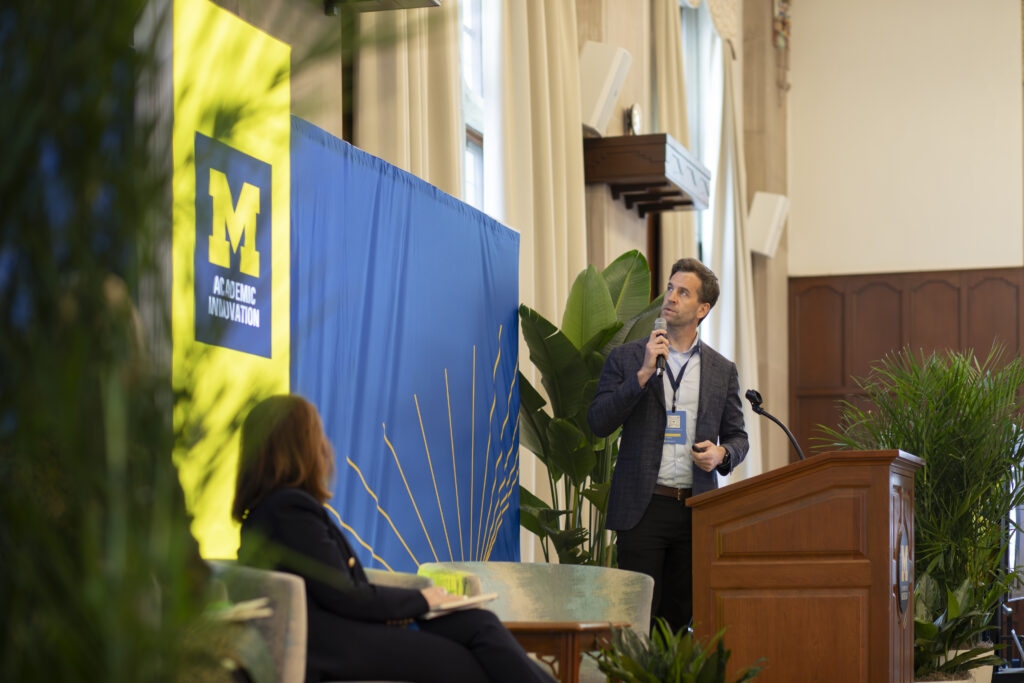
“The decisions being made right now are shaping what the future of learning will look like,” said James DeVaney, associate vice provost for academic innovation and founding executive director of the Center for Academic Innovation. “This is a moment for institutions with deep expertise to help define that future. Higher education is uniquely positioned to make a meaningful impact, but doing so will require sustained investment and intentional collaboration. That’s why partnerships between higher education and industry are essential to building what comes next.”
A Workforce in Transition
Across panels, speakers emphasized that AI is not simply replacing jobs but transforming them.
“Jobs of today are going to become the tasks of tomorrow,” said Tigran Sloyan, CEO of CodeSignal, describing how work is being restructured around human-AI collaboration.
This shift is already affecting early-career pathways. Employers are placing greater emphasis on experience, while traditional entry-level roles are becoming less accessible. There is often a gap between what a credential represents and the expectations of employers.
That gap is particularly evident in access to internships. Chris Parrish, co-founder and president of Podium, noted that millions of students compete for a limited number of internships each year, making it increasingly difficult to gain the experience employers demand.
“If you miss out on an internship, you’re twice as likely to be unemployed,” Parrish said.
These challenges can be addressed by higher education institutions, with Parrish noting his company collaborates to connect educational programs to professional work experiences, and that experiential learning must become a core part of academic design.
“We need to move from a static catalog of knowledge to a learning graph,” argued Quentin McAndrew, global academic strategist at Coursera, who noted AI’s potential to help craft tailored lifelong learning using AI as a pipeline to source employer needs.
McAndrew was also one of several speakers who pointed out that while the pace of change is accelerating, it doesn’t mean universities can elide their responsibility to explore AI’s role in learning or to teach students about AI tools. But with shifts happening so quickly, higher education needs to anchor on what it does best.
“There is no end date to learning. … when the world is changing so fast that it’s hard to keep up, humanities becomes the foundational operating system of what we do.”
Students Already Navigating AI
While institutions grapple with these changes, students are already adapting.
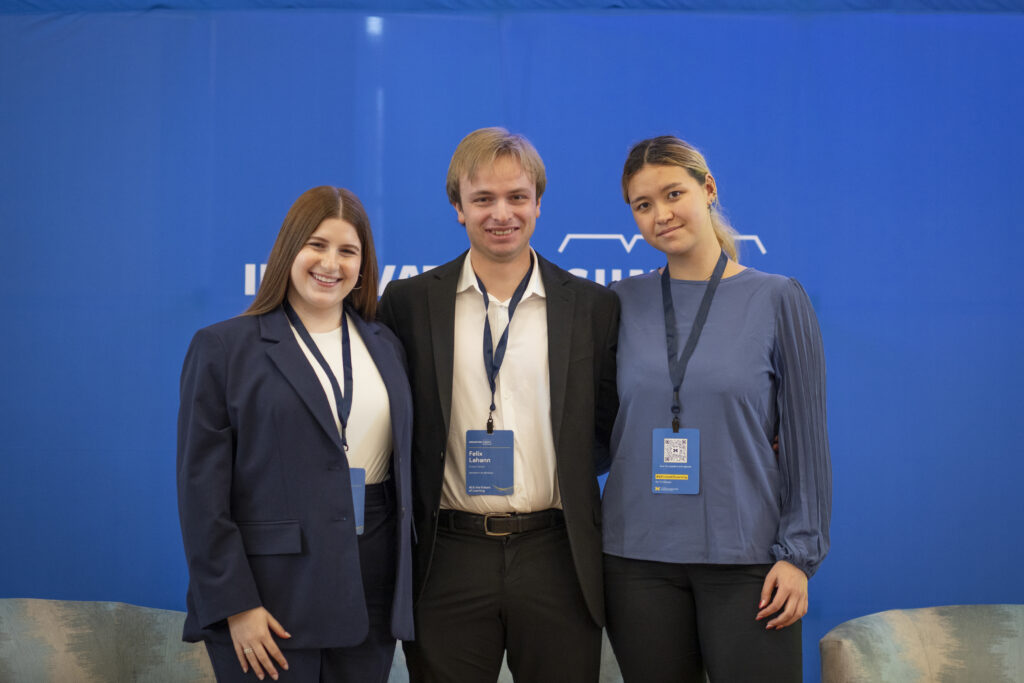
The summit featured a panel of three current undergraduate students at various stages of their educational journey. Each described widespread, daily use of AI tools for studying, writing, and coding.
“I think myself and my friends use it every day,” said Alexa Sohn, a freshman at the university, describing how AI tools have become integrated into routine academic work.
Yet students also pointed to a lack of clarity from institutions. Policies on AI use vary widely across courses, leaving many unsure how to use the technology appropriately.
“I don’t think many faculty members are dealing with it,” Sohn said, describing inconsistent expectations across classes.
Felix Lahann, a junior studying economics, emphasized that AI literacy is quickly becoming essential for the workforce.
“AI has become an essential skill for the incoming job market,” he said.
The students wanted clarity, consistency, and dedicated courses focused on ethical use, skill building, and exploring the various high-powered AI tools in the marketplace.
From Micro-Skills to Mastery
Several speakers argued that the rise of AI should prompt a shift away from narrow, short-term skill-building toward deeper, more durable forms of learning.
Agarwal expressed concern about the growing emphasis on “micro-skilling,” where narrow training on discrete tasks is often delivered through very short videos. He noted many of these tasks can now be performed by AI systems.
“AI can do all of these micro skills,” he said, calling instead for a renewed focus on “deep and meaningful” learning that develops long-term intellectual capacity. That aligned with CodeSignal’s Sloyan, who noted that if today’s skills become tomorrow’s AI-aided tasks, then it is more critical than ever for professionals to have core skills in reasoning, analysis, and communication to move from specialist to a manager of agents or people that leverage AI.
In a world where careers no longer begin at a fixed starting point, higher education’s role becomes less about preparing students for a single moment and more about preparing them for a lifetime of change. While the hard work is ongoing to adapt to this time of change and define the role of higher education within it, the highest forms of learning have always been hard fought and well-earned.
“Without productive struggle, something essential disappears. … We need the friction that produces learning – that is something you should be protecting and not optimizing,” DeVaney said.
The questions are hard, but the conversation must continue, and higher education needs to be driving that conversation – with faculty, with students, and with industry.