Mindy Arbaugh, Content Specialist
While academic and industry leaders offered assessments and forecasts at the AI & the Future of Learning Summit, a trio of student panelists shared their perspective from the receiving end of higher education.
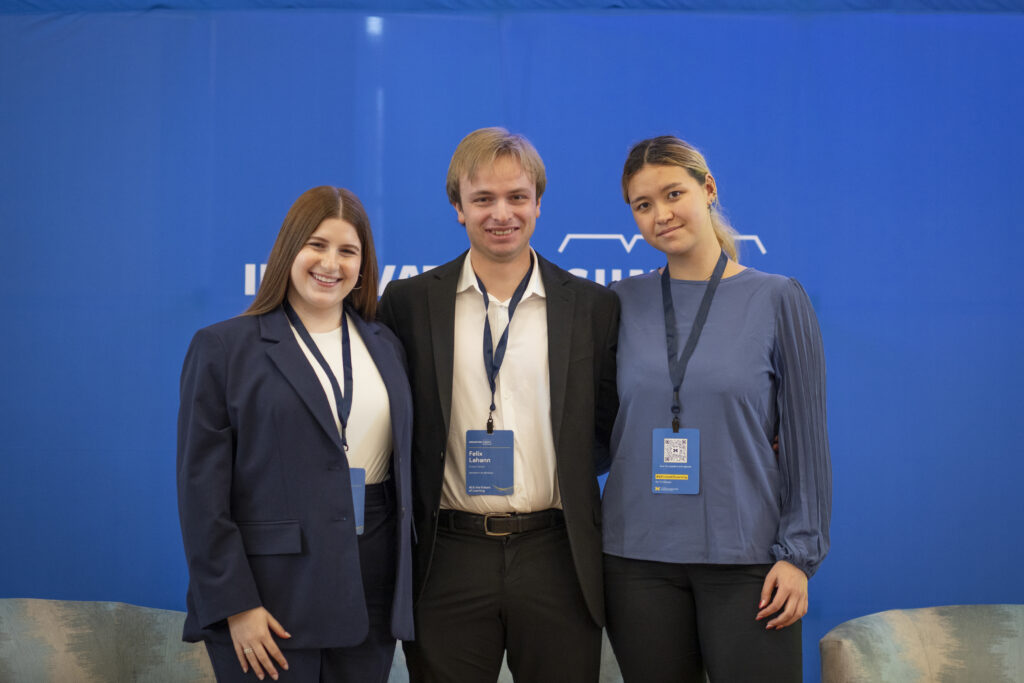
During the lunchtime session, “The View from the Learner—Does This Actually Work?”, three University of Michigan undergraduate students recounted their experiences with AI, its presence (or prohibition) in the classroom, and what more they need as they look ahead toward their careers.
First-year student Alexa Sohn, junior Felix Lahann, and senior Tatyana Teslya spoke with School of Information associate professor Christopher Brooks, and quickly reached a consensus—they wanted more AI instruction and guidance.
“I think developing frameworks to use AI effectively is important as a student,” said Lahann, an economics major with a minor in data science. “A lot of job applications require you to have AI skills, and learning this as an essential part of our curriculum is important. It’d be cool to have some sort of standardized message from the university.”
Inconsistent AI integration in their courses was a source of frustration for the students, who all use AI tools on a daily basis. Each pointed to a broad range of policies in their classes, from instructors who fully prohibit AI use to those who teach how to use it and make it part of the assignments.
“There’s just a big lack of consensus overall, no matter the classes I’ve taken, whether it be my major’s classes or more gen eds,” said Sohn, who is double-majoring in international relations and political science. “It’s just very frustrating as a student.”
For Teslya, who is graduating this spring with a computer science degree, that frustration has morphed into a real sense of worry as she and her peers enter the job market.
“No one’s excited about it, especially for myself and my peers who want to go into AI,” she said, pointing to the number of existing workers who are getting real-world AI experience. “Because more experienced workers are pivoting toward that, it’s kind of creating a deficit in the amount of spots for new grads, especially since new grads don’t have the extensive AI education that I think in the future we will have.”
Their current AI education is mainly their own use of different tools. Sohn discussed her social circle’s daily use of “the Chat,” or ChatGPT, as a way to create study guides, brainstorm, and edit. Lahann loves Google’s Notebook LM and its podcast feature, which summarizes uploaded materials, such as class lectures and notes, into a conversation between two AI hosts.
Yet while they all embraced use of AI, the students were clear on the line between its benefit as a support tool and the temptation to use it to do their work.
“I do think a majority of students still value learning, they still chose to come to the university, they still want to know more,” said Teslya. “The people I’ve met generally want to use it responsibly. They just aren’t exactly sure how.”
Lahann said in a few of his classes, the assessments have moved back toward written and oral exams, including writing code with pen and paper, in an attempt to counter improper AI use. For some of his peers, it’s been a wake-up call.
“They walk into these types of exams and they are sort of taken aback because they used AI as a crutch for so long, they don’t really know how to be successful, and actually understand the content,” he said.
All three panelists agreed that what was most needed was useful and impactful AI instruction. Sohn suggested an AI ethics class would help students make informed decisions on utilization, while also providing a more consistent message from the university about AI use. The ideas and suggestions brought up during the summit were interesting, Sohn said, but having them trickle down into the classroom was going to be the real challenge.
“It’s one thing to say we’re going to do this, but how are we going to do this,” she said. “The follow up and the follow through, I think, is the most critical part.”