Faculty develop custom roleplay simulations where learners can build assessment skills in realistic scenarios
Mindy Arbaugh, Content Specialist
Barbara Hiltz knew she was pushing boundaries with her next question.
“You’ve got an issue with drinking — why don’t you tell me about that?”
The “student” she was interviewing, an artificial intelligence-generated avatar named Jordan Reyes, paused before responding curtly, “I mean, I don’t know.”
Hiltz, academic program director and clinical associate professor at the School of Social Work, was demonstrating her department’s roleplay simulator, in which students can practice their interviewing skills with AI-generated subjects. The simulation gives students a safe space to test their knowledge and to make mistakes, such as asking a simulated student about its alcohol consumption.
“Simulations have been a big part of social work education for our students for the last few years,” Hiltz said. “They offer us a chance to have our students practice the things that they were learning without doing harm.”

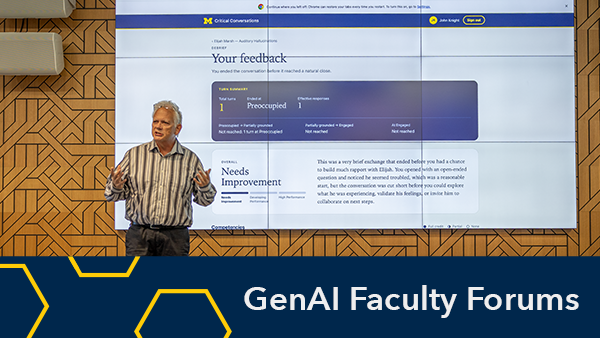
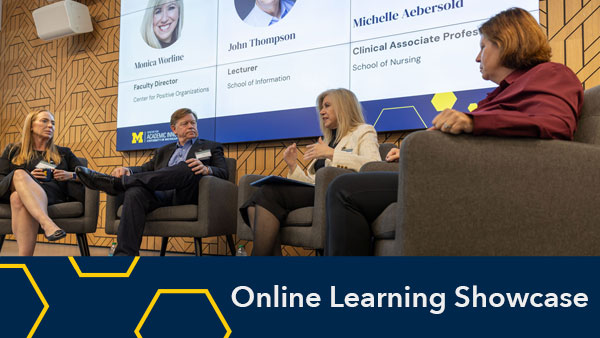
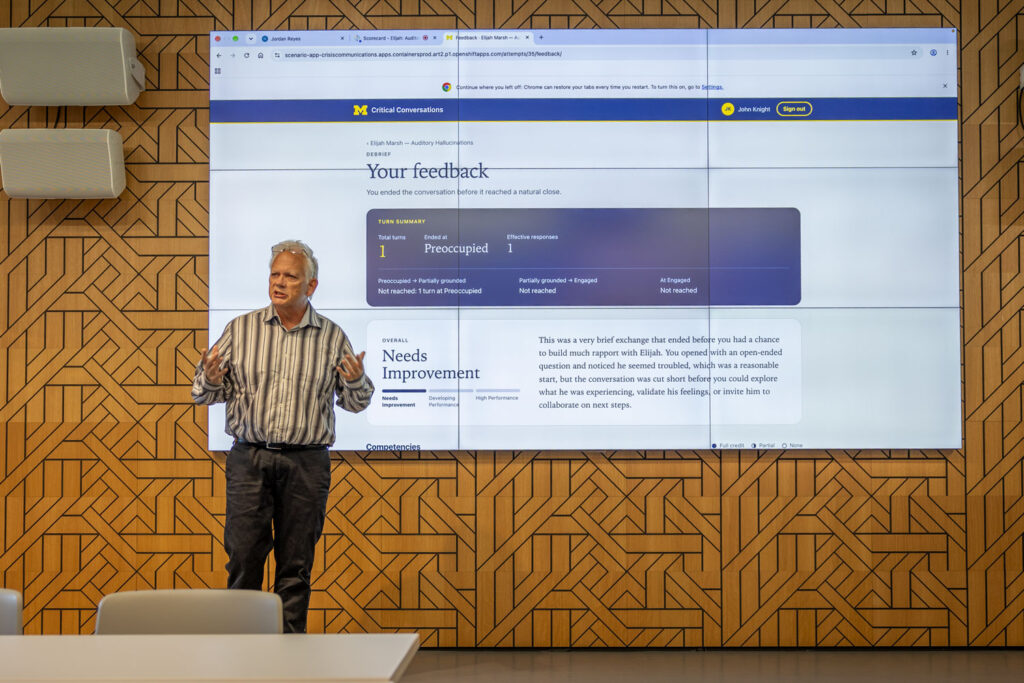
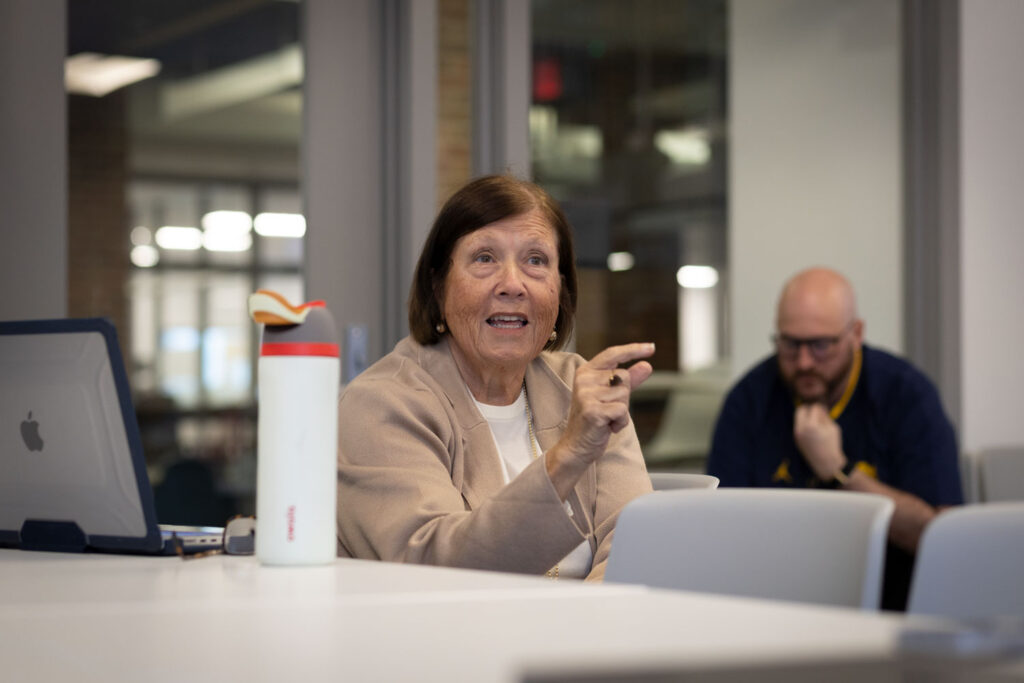
Hiltz and John Knight, clinical assistant professor with the School of Nursing, were presenting their AI-powered roleplay simulation projects as part of the AI Faculty Forum series at the Center for Academic Innovation.
Hiltz and Knight both received financial and in-kind developmental support from the center for their projects through the University of Michigan Academic Innovation Fund.
Julien DePauw, director of the EdTech Accelerator at the center, opened the AI Faculty Forum by sharing how workplace simulation was a rising topic of interest, especially among faculty looking to better prepare their learners for future careers.
“It helps students go through real scenarios, it helps them to work on professional skills and even to get personalized feedback on how they are positioned in this real scenario,” DePauw said. “AI roleplay simulation is one of the core topics that we are interested in here at the center.”
Building an Engaging Experience
Knight and his School of Nursing colleagues designed their AI simulation activity to mimic performing a needs assessment on a patient experiencing an active mental health crisis. In the past, the students would practice on each other, taking turns portraying a patient in psychosis.
“The authenticity and realism is not there. We needed the learner to highly engage,” Knight said.
The solution was a dynamic AI avatar that nursing students could interact with directly. Knight and his colleagues built their roleplay activity to include an AI-simulated coach as well as a patient. The learners first meet with the coach to get background, then perform a needs assessment on the patient, followed by post-assessment feedback.
Knight said the feedback was an important component of the simulation, including how it was delivered to the learner. Nursing students can choose to engage with the simulated coach, or they can download the output. The roleplay simulation also includes a dashboard that assesses how effective the student’s patient interaction is in real time.
“It lets the students know where they’re at in the process in the simulation, and it gives them areas to improve upon, and what to try next time,” Knight said.
Scaling Simulation Benefits
Hiltz said building the AI roleplay simulation tool has allowed them to expand the scenarios they want their social work students to experience. Their curriculum was big on simulated experiences, with students logging more than 10,000 roleplay simulation attempts in past years.
When she saw the opportunity to incorporate AI into the simulated activities, it was a chance to overcome some of the limitations of the more traditional simulations, such as having a restricted list of responses or students memorizing the script to cruise to a good mark. With AI, students can respond however they want, and the simulation reacts differently almost every time, keeping the students on their toes.
“The biggest part of the build was the character, figuring out how we wanted our character to respond,” Hiltz said. “We really wanted it to respond in a way that we thought an actual client would.”
Barbara Medvec, one of Knight’s collaborators and clinical associate professor at the School of Nursing, said using AI to develop their roleplay simulations has allowed them to serve more students in a deeper and more efficient way.
“The speed that we can do AI work compared to what we did with VR, XR, or other types of modalities is so much faster, and it’s actually adopted by the students more quickly,” she said.
Knight advised the faculty members attending the forum to cast aside any hesitation or concern over mastering new technology. Ultimately, he said, providing the students a safe, guided place to hone their communication and assessment skills will produce better results and better prepare students for the workforce.
“If you would have told me a year ago that we would have applications like this, I would have laughed. We did not start with some strong tech background,” Knight said. “Put in the sweat equity. It will pay off for you.”
Call for Proposals Open
DePauw said the center is exploring an array of AI-powered roleplay simulations, including text-based, voice-based, avatars, digital twins and more. The center awards funds to faculty whose winning proposals effectively integrate the simulations into their courses in order to provide the greatest potential impact on learners.
DePauw said the center’s Call for Proposals is a key opportunity for U-M faculty seeking to improve teaching and learning through the implementation of innovative technology. In addition to AI-powered roleplay, other areas of interest for potential partnerships include:
- Personalized Learning
- Scalable Assessment and Feedback
- Skills Validation and Career Readiness
- Critical Thinking and AI Literacy
Applications are still being accepted as part of the center’s Call for Proposals. The deadline to apply is Jan. 15, 2027. For more information or to schedule a consultation, please email [email protected].