Sean Corp, Associate Director of Communications
Artificial intelligence is transforming higher education at a remarkable pace, prompting universities to rethink how they teach, support students, and prepare graduates for a rapidly changing world.
To help advance those conversations, the Center for Academic Innovation is launching the AI Futures keynote speaker series, bringing nationally recognized leaders in higher education, educational technology, and learning sciences to the University of Michigan during the 2026–27 academic year. The series invites faculty, staff, students, and higher education professionals to engage with leading thinkers whose work is shaping how colleges and universities respond to one of the most significant technological shifts in decades.
“Artificial intelligence is prompting every university to reconsider how we teach, how students learn, and how institutions can best fulfill their educational mission,” said James DeVaney, founding executive director of the center and associate vice provost for academic innovation. “By bringing together nationally recognized leaders with different perspectives and experiences, we’re creating space for our community to examine these questions thoughtfully and help definehigher education’s path forward.”
AI Futures Keynote Speaker Series
The series features three distinguished speakers whose work spans classroom innovation, institutional leadership, and human development. All keynotes will be held from 1-2 p.m.

Designing AI to Support Student Learning
Kelly Miller, Harvard University
Date: Sept. 30, 2026
Location: Event Space at CAI 317 Maynard St.
How much students learn with AI may depend less on the technology itself than on how educators design the learning experience around it.
Kelly Miller, a Harvard University applied physics lecturer and co-founder of the collaborative learning platform Perusall, will share evidence from several years of research into AI-supported learning in introductory physics. Her work includes controlled studies of AI tutoring and the semester-long integration of an AI learning platform into a course.
Miller will examine how pedagogical design shapes students’ interactions with AI, how students actually use the technology and how those interactions relate to learning outcomes. For faculty considering AI in their own courses, her research offers an evidence-based perspective on making thoughtful choices about when and how to use AI — and designing tools and learning experiences that extend effective teaching rather than replace it.
Building AI Pedagogy with Socratic Tutors
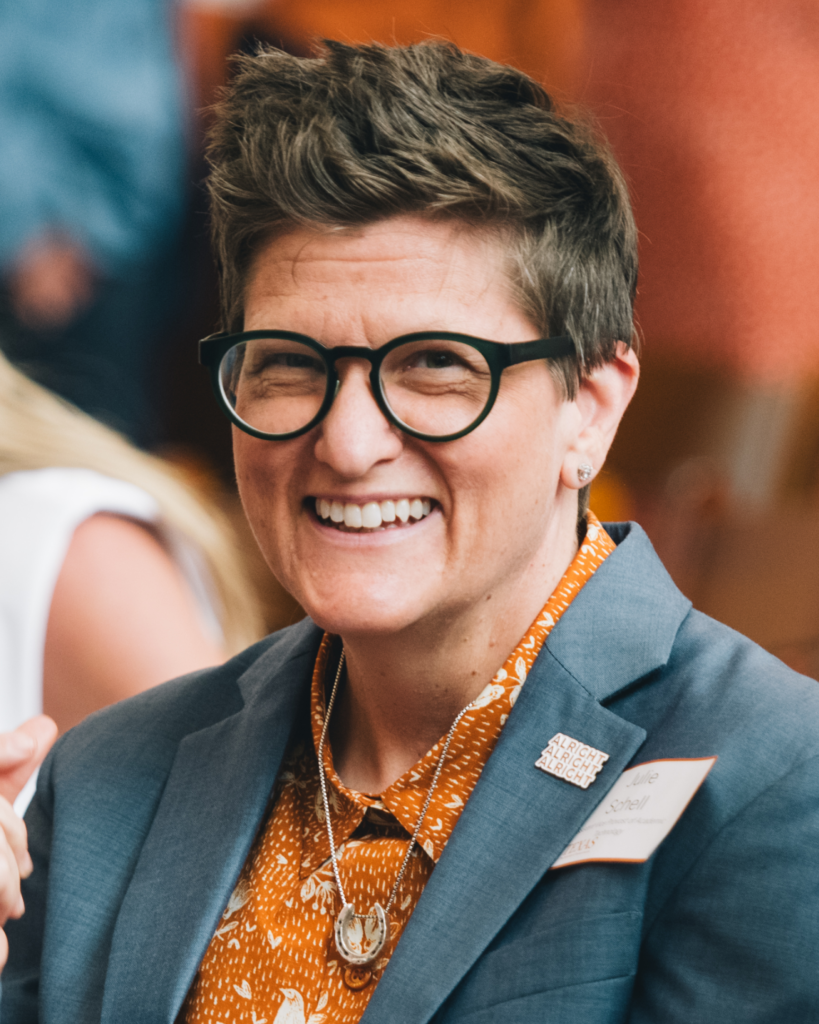
Julie Schell, University of Texas at Austin
Date: Nov. 17, 2026
Location: Ballroom at the Michigan Union
What happens when faculty move beyond debating AI’s role in education and begin designing, testing, and evaluating new approaches in their own courses — without a playbook?
Julie Schell, assistant vice provost of academic technology and director of the Office of Academic Technology and founder of UT Sage, a university-supported generative AI platform at The University of Texas at Austin, will share case studies of faculty across disciplines building AI pedagogy from the ground up with Socratic AI tutors.
Through examples of tutor prompts and instructions, Schell will examine the teaching challenges faculty wanted to address, the design choices they made, and what they learned. Drawing on a year of student-tutor interactions, she will also explore evidence that students use the tutors to practice metacognition, process errors, and direct their own learning. The findings offer faculty a glimpse of how thoughtfully designed AI might create new opportunities for students to do the difficult thinking that meaningful learning requires.

Developing Relational Intelligence in the Age of AI
Isabelle Hau, Stanford University
Date: Jan. 27, 2027
Location: Pendleton at Michigan Union
The Industrial Revolution elevated IQ and the cognitive abilities needed for an economy increasingly built on knowledge and analytical skill. By the late 20th century, EQ expanded our understanding of intelligence to include understanding ourselves and others. Isabelle Hau believes the AI revolution calls for another evolution.
Hau, executive director of the Stanford Accelerator for Learning and author of Love to Learn, will introduce relational intelligence, or RQ: the capacity to build trust, make meaning together, connect across differences, collaborate, navigate conflict, and repair relationships.
As AI becomes increasingly capable, Hau will consider why these human capacities may become more important and what role universities can play in developing them alongside AI fluency. Her talk poses a defining question for higher education: If AI changes what it means to be intelligent, how should education rethink what we teach, measure, and value?
Learning From Leaders in AI
Collectively, the three keynote speakers represent complementary perspectives on the future of higher education, from advancing teaching and learning, to leading institutional AI strategy, to ensuring that human development remains at the center of educational innovation.
“Each of these speakers brings a distinct perspective on a question every university must confront: How can we harness AI to deepen learning while strengthening the human capacities that education should cultivate?” DeVaney said. “By examining emerging practices, evidence, and ideas together, our community can move beyond reacting to change and take a more active role in shaping what comes next.”
The AI Futures keynote speaker series is part of the Center for Academic Innovation’s broader 2026–27 event series exploring the future of higher education. Together with the Online Learning Showcase, Generative AI Faculty Forums, and Innovation Blend series, the collection of opportunities provides faculty with an ongoing opportunity to exchange ideas, reflect on emerging technologies, and help shape the future of teaching and learning at the university.