Sean Corp, Associate Director of Communication
How should universities prepare students for a future shaped by artificial intelligence? Which human skills will matter most as technology transforms the workplace? And how can institutions continue to create meaningful, accessible learning experiences amid rapid technological change?
These are among the defining questions facing higher education today—and the University of Michigan Center for Academic Innovation is creating new opportunities to explore them.
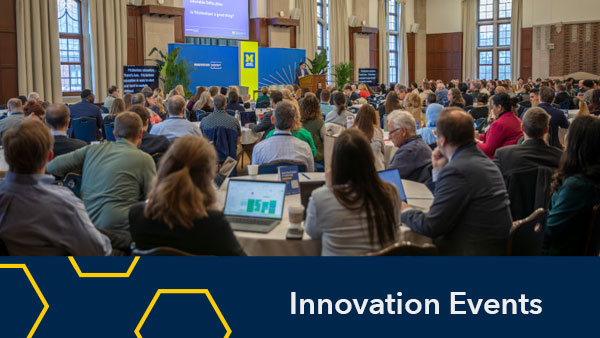
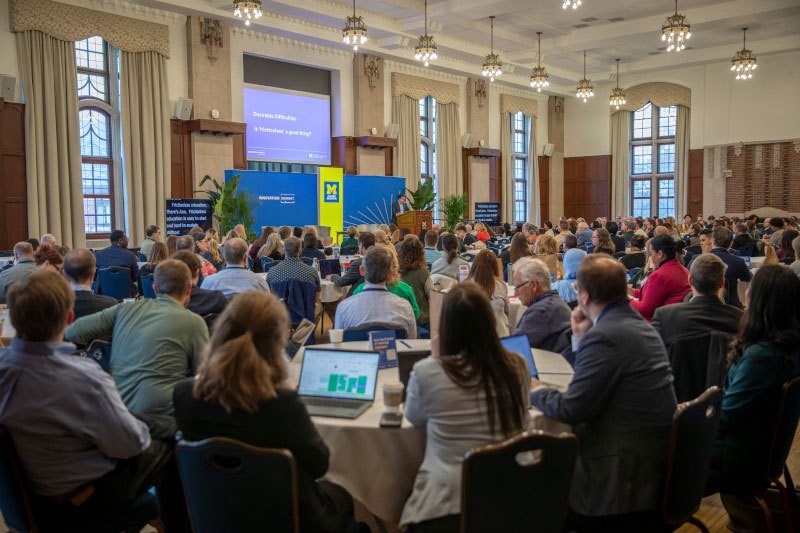
Throughout the 2026–27 academic year, the center will host more than a dozen events that bring together internationally recognized scholars, faculty innovators, and higher education professionals to examine the future of teaching, learning, and educational innovation. Bringing people together in various formats and on multiple themes important to faculty, students, and the future of education enables people to engage with emerging ideas and connect with colleagues across disciplines.
“Faculty need different kinds of conversations at different moments,” said James DeVaney, the founding executive director of the center and the associate vice provost of academic innovation. “A nationally recognized expert can challenge assumptions and introduce new possibilities. A colleague can offer practical insight grounded in the classroom. And an informal gathering can create space to work through a shared problem. We designed this year’s events to make room for each of those experiences and to help our community turn new ideas into stronger teaching and learning.”
Exploring AI’s Future in Education
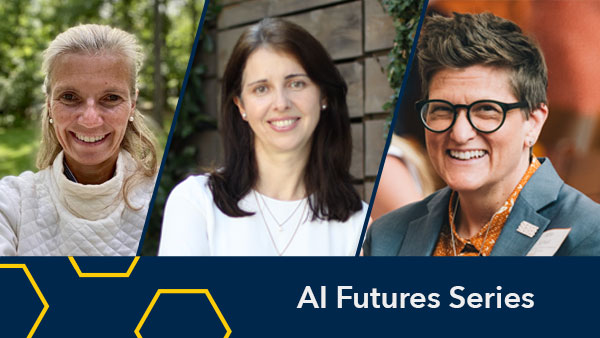
The AI Futures keynote speaker series will welcome three nationally recognized leaders whose work is shaping conversations about artificial intelligence and higher education.
The series begins Sept. 30 with Kelly Miller, a Harvard University applied physics lecturer and co-founder of the collaborative learning platform Perusall. Drawing on several years of research in introductory physics, Miller will share findings from controlled studies of AI tutoring and a semester-long integration of an AI learning platform. She will examine how course design shapes students’ interactions with AI, how students actually use the technology, and how those choices relate to learning outcomes.
On Nov. 17, Julie Schell, assistant vice provost of academic technology and director of the Office of Academic Technology at the University of Texas at Austin, will turn to what faculty are learning by experimenting with AI in their own courses. Schell founded UT Sage, a university-supported generative AI platform at The University of Texas at Austin. She will share case studies of faculty designing Socratic AI tutors and evidence from student interactions with them, including how students use the tutors to practice metacognition, process errors, and direct their own learning.
The series concludes Jan. 27 with Isabelle Hau, executive director of the Stanford Accelerator for Learning and author of Love to Learn. Hau will argue that the AI revolution calls for an evolution in how we think about intelligence. Building on IQ and EQ, she will introduce relational intelligence, or RQ: the human capacity to build trust, connect across differences, collaborate, and navigate conflict. Her talk will ask what universities should teach, measure, and value as AI becomes increasingly capable.
U-M Faculty Connect with Peers
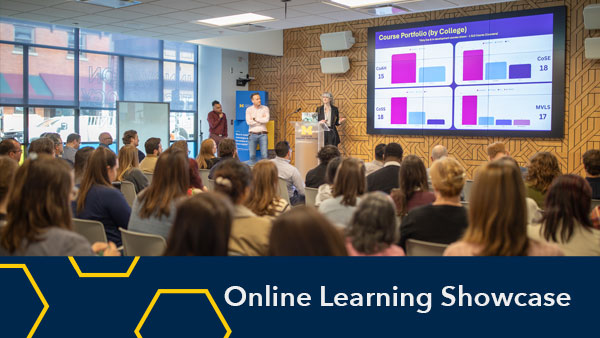
The keynote series is complemented by the center’s annual Online Learning Showcase, which highlights how U-M faculty, instructional designers, and researchers are advancing online and hybrid learning. Through presentations, demonstrations, and discussions, participants will explore new approaches to digital course design, learner engagement, and educational technology while seeing how innovative ideas move from experimentation into practice.
Throughout the academic year, faculty can continue those conversations through the Generative AI Faculty Forum series, a peer-learning series in which U-M instructors share how they use generative AI in teaching, research, and professional practice. Each session pairs faculty colleagues to discuss their work, exchange practical insights, and invite conversation around the opportunities and challenges of AI in higher education. Faculty co-hosts will be Barb Hiltz and John Knight, Kevin Miller and Frederique Laubepin, Pete Bodary and Yang Chang, and Dave Bridges and Xu Wang.
The Innovation Blend series offers another opportunity for faculty to connect around topics shaping the future of higher education in an informal, discussion-based setting. Hosted over coffee, this year’s series brings together faculty innovators to explore themes including applied and responsible AI, leadership, data-informed decision-making, healthcare innovation, advanced technology, communication, and the durable human skills learners need in a rapidly changing world. Faculty hosts include Christopher Brooks, Paula Caproni, Raj Mangrulkar, Cheri Alexander, and Chinedum Okwudire.
By bringing together leading thinkers, experienced practitioners, and faculty innovators in a variety of settings, the center aims to foster the conversations, collaborations, and shared learning that will help shape the future of teaching and learning.
“Academic innovation is a collective endeavor,” DeVaney said. “It advances when people from different disciplines come together to challenge assumptions, test ideas, and learn from one another. Our aim is not simply to host events, but to create the conditions for those exchanges to produce new collaborations and meaningful improvements in teaching and learning.”